A generative adversarial network (GAN) uses two competing neural networks: a generator creates synthetic data, while a discriminator judges whether it looks real. Their competition improves both generation and evaluation, producing increasingly convincing results. section 9.30
GANs are useful when a model must create realistic images or other media rather than merely classify existing examples. The generator proposes a result, the discriminator compares it with real examples, and the resulting error guides further improvement. section 9.30
A simple GAN interaction works like a contest:
- The generator creates a potential solution, such as a landscape image. section 9.30
- The discriminator examines the generated result alongside real landscape images and estimates whether the result is realistic. section 9.30
- An error or cost is fed back so the generator improves its creations and the discriminator improves its judgments. section 9.30
From a 2D chair to a 3D object
A GAN can estimate missing information in a two-dimensional chair image and generate a corresponding three-dimensional chair. The task demonstrates how adversarial generation can create structure from an incomplete source. section 9.30
Figure 9.34 Simple example of a GAN
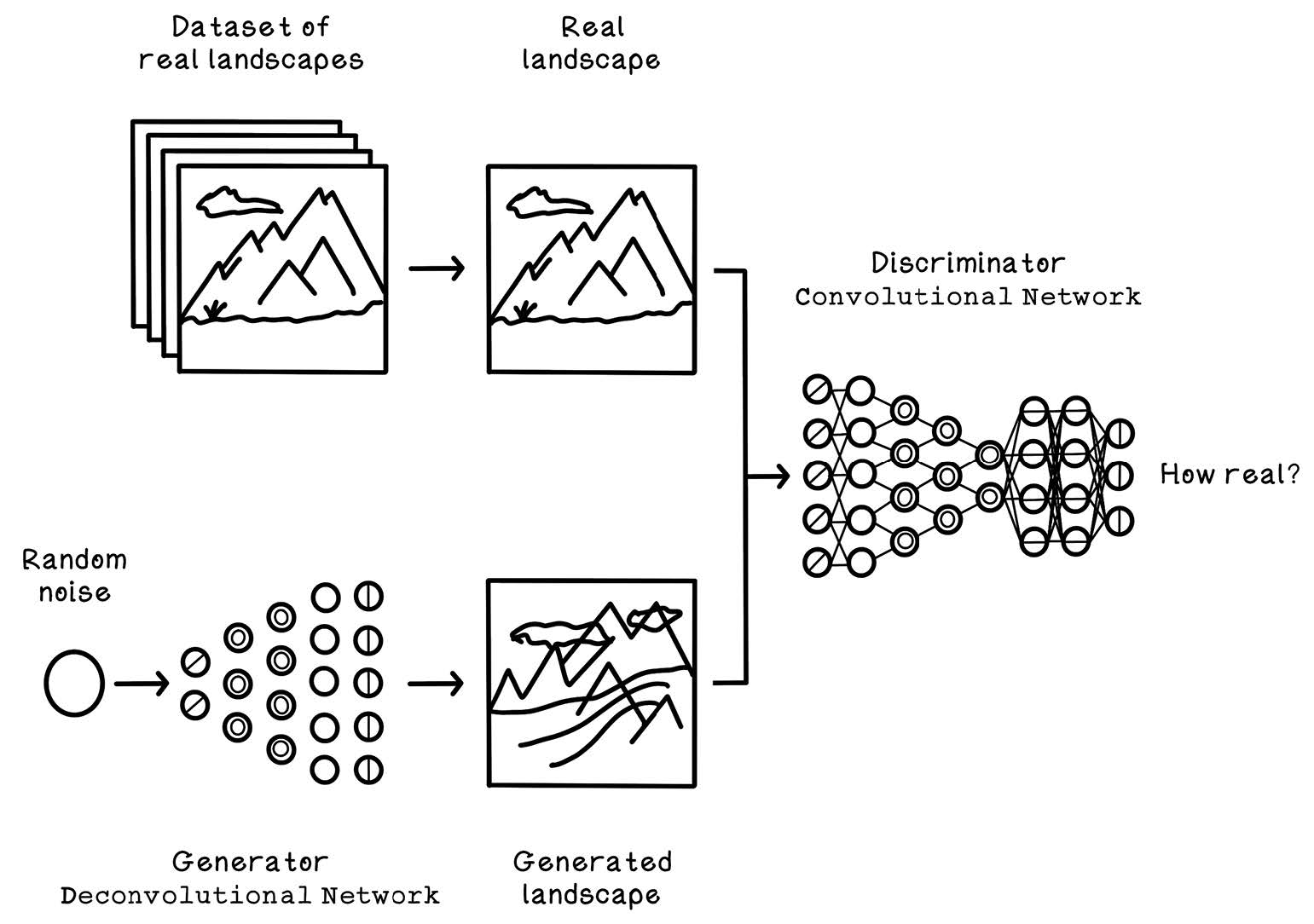
Use the simple GAN diagram to follow the generator–discriminator competition and the feedback loop that improves their results. section 9.30
GANs can generate convincing fake videos, including deepfakes, and can overlay hairstyles on faces. They also belong to the broader family of generative image models, alongside diffusion models; CNNs and U-Net have become standard approaches for modern image generation. section 9.30 section 12.1











