A generator is the creative component of a generative adversarial network (GAN). It transforms input noise into synthetic data, such as images or text, that resembles the real data distribution. section 10.4 section 10.4.1
The generator operates through a learned transformation:
- Starts with a noise vector sampled from a simple distribution, commonly Gaussian or uniform. section 10.4.1
- Passes the noise through learned layers that progressively add characteristics of the target data. section 10.4.1
- Produces synthetic data and uses a loss function to measure how closely it resembles real data. section 10.4.1
- Improves through adversarial feedback as the discriminator learns to identify generated examples. section 10.4.3
Noise into synthetic data
For image generation, convolutional or transposed convolutional layers can transform a random noise vector into an image. For text generation, recurrent layers can perform the corresponding transformation. Binary cross-entropy is one example of a generator loss used to encourage outputs the discriminator classifies as real. section 10.4.1 section 10.4.3
Figure 10.1 Representation of a GAN
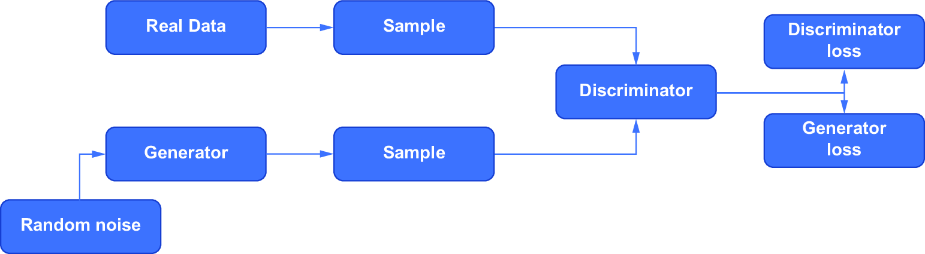
Use the GAN representation to trace how the generator and discriminator interact around synthetic and real data. section 10.4.1











