A generator is the GAN component that converts random noise, or a latent vector z, into synthetic data G(z) resembling real training data X. section 16.2.3
During adversarial training, the generator improves at producing realistic outputs while the discriminator improves at distinguishing them from real data. GANs can produce highly realistic data, but balancing both networks makes them harder to train than VAEs. section 16.2.3
The generator’s practical role includes:
- Sampling random noise from a uniform or Gaussian distribution. section 16.2.3
- Mapping that noise to synthetic data that approximates the training distribution. section 16.2.3
- Supporting GAN-based outlier detection alongside the discriminator after training. section 16.2.3
Figure 16.4 GAN network. This includes two neural networks: the generator (G) and discriminator (D). The generator learns to take random input (z) and convert this to synthetic data (G(z)) that is very similar to real data (X). The discriminator learns to distinguish synthetic data generated by G from the real data. They are trained together such that over time both become more powerful, with the generator being able to produce increasingly realistic data and the discriminator being able to detect increasingly subtle deviations from real data. Once trained, both the generator and discriminator may be used for outlier detection.
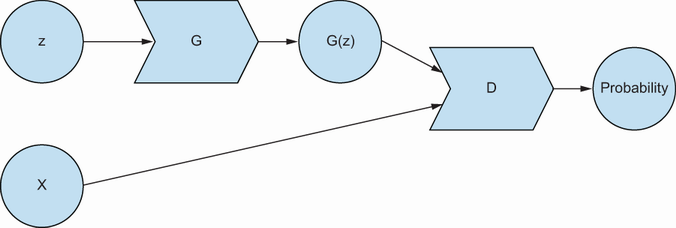
Trace how random input z becomes synthetic data G(z), while the discriminator compares it with real data X. section 16.2.3











