Go is a simple, statically typed, compiled language for building efficient, reliable software. It targets native machine code and emphasizes readable, idiomatic programs that remain maintainable as teams and systems grow. Its design favors pragmatic simplicity over feature-heavy abstraction, while supporting modern multicore and networked workloads. section 1.0 section 1.10
Types are known at compile time, letting the compiler check consistency, optimize known memory layouts, and give tools useful information while code is edited. Type inference can still keep ordinary declarations concise: a value assigned with := can have its type inferred without losing static checking. section 1.3.1
Go’s central traits work together in everyday programs:
- Compile source directly into native machine code for a target operating system and architecture. section 1.3.2
- Package dependencies into a single executable binary, simplifying deployment where only an operating system is needed to run it. section 1.3.2
- Run concurrent work in lightweight goroutines and coordinate it through channels that send and receive messages. section 1.4
- Use a flat type system that favors composition; interfaces are satisfied implicitly for runtime polymorphism. section 1.10
- Rely on a comprehensive standard library and integrated tooling for broad programming tasks. section 1.10
A runnable starting point
A Go executable is organized as a package. A main package can import fmt, assign a greeting with type inference, and print it from main. Initialize a module with go mod init, then use go run . to compile, link, and run the program through the central go tool. section 1.3
Figure 1.1 The Go compiler compiles code with all necessary dependencies into a single executable binary targeted for a specific operating system and architecture.
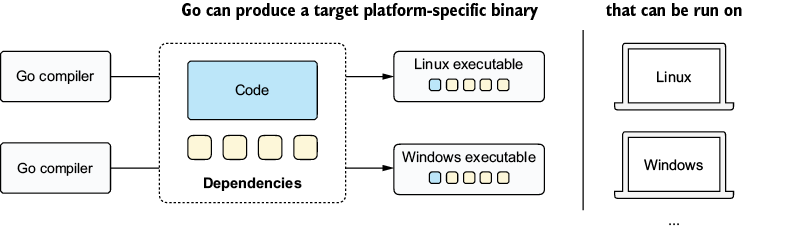
The compilation diagram shows source and dependencies becoming one executable for a chosen operating system and architecture. section 1.3.2
Idiomatic Go also affects design decisions. Start with small, cohesive packages and concrete types; introduce extra packages, indirections, or interfaces when a real need emerges. This keeps code simple while allowing later refactoring and evolution across domain boundaries. section 8.8.1










