Go is designed for readable, efficient, high-performance concurrency. It provides tools for expressing concurrent executions, coordinating them, and choosing between message passing and shared-memory synchronization. section 1.5 section 1.1
Concurrency helps software perform independent work at the same time, use multiple CPU cores, remain responsive during input/output waits, and model complex business interactions. A payroll calculation that exceeds an overnight processing window illustrates why this matters. section 1.0 section 1.1
Go’s main concurrency building blocks include:
- Goroutines provide lightweight units of concurrent execution; programs can create them without directly managing resource allocation. section 1.5.1
- Channels let goroutines exchange messages and synchronize their work. section 1.5.1
- CSP-style design isolates goroutines and has them communicate through channels, reducing the risk of race conditions. section 1.5.2
- Classic primitives such as mutexes and condition variables remain available when shared memory better fits the problem or offers better performance. section 1.5.2
Parallelizing payroll work
A payroll system processing tens of thousands of employees can divide independent calculations among concurrent executions instead of relying on one long sequential run. Goroutines can perform the work, while channels can communicate results and coordinate completion; shared-memory primitives remain an alternative when the task requires them. section 1.0 section 1.5.1
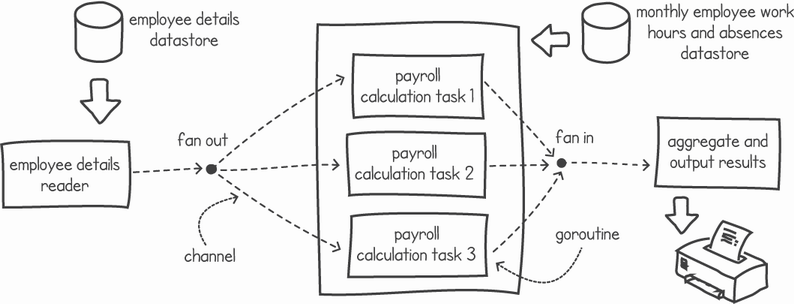
Use the figure to visualize isolated goroutines communicating and synchronizing through channels in a CSP-style Go application. section 1.5.2










