liveBook · Manning

Go

As explained in Shipping Go: Develop, deliver, discuss, design, and go again

A statically typed, compiled programming language designed for concise syntax, concurrency, and efficient software development.

Go is the concrete implementation language for a small product that needs to move from working code to shipped software. The surrounding workflow favors small increments, feedback loops, documentation, and automation over language-specific process rules. section 1.0

A practical Go project starts with a README that explains its purpose, dependencies, setup, milestones, common uses, and troubleshooting. This turns the repository into a map for contributors and a lab notebook for reproducing development work. section 2.1

Repeatable Go setup

A Unix-like project pins Go version 1.18 in a Makefile, provides setup and installation commands, initializes the PATH, and exposes those commands through README instructions such as `sudo make setup`. A TODO can mark unsupported macOS setup without blocking the first useful increment. section 2.2

Figure 2.1 The README document is a pointer to all other documents within your product. This will help enhance the developers’ understanding of how to contribute, run, build, or debug your product.
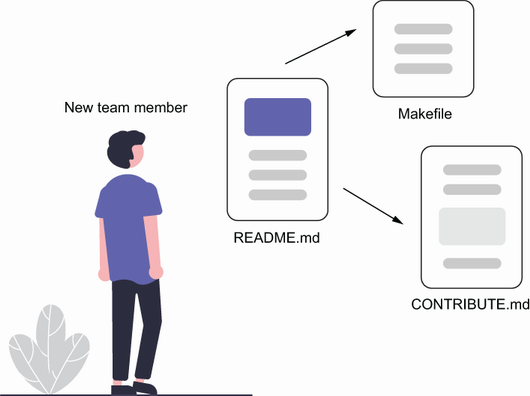
Use the README map to connect contribution, setup, building, running, and debugging information across the product. section 2.1


How Shipping Go: Develop, deliver, discuss, design, and go again covers it

How deep it goes
Explains Go through project setup and workflow examples, stopping short of language internals or detailed syntax.
Examples
Uses a Hello API repository, Go 1.18 setup, a Makefile, PATH initialization, and README installation commands.
What it assumes
Assumes programming ability and familiarity with writing code, while teaching repository setup and delivery practices around Go.
What you can do after
Builds and documents a repeatable Go project setup using a Makefile and README.
How it connects
Connects Go with continuous integration, README documentation, Makefiles, Unix-like environments, and GitHub Actions.

Also explained in

Compare how 11 books explain Go →

Related concepts

This explainer was generated by Manning's knowledge graph from the text of Shipping Go: Develop, deliver, discuss, design, and go again. The section links point to the parts of the book it draws on.








