A graph convolutional network (GCN) updates node representations by aggregating information from graph neighborhoods. It serves as a GNN encoder for downstream node-classification and link-prediction tasks. section 12.0
A practical GCN workflow follows an encoder–decoder pipeline:
- Convert semistructured objects and interactions into a graph. section 12.0
- Encode graph information with a GCN, then optimize a decoder for the selected task. section 12.0
- Evaluate predictions with precision, recall, F1-score, and confusion matrices. section 12.1.5 section 12.2.5
Two applied uses
For anti-money-laundering analysis, a GCN classifies financial-transaction nodes as licit or illicit. For movie recommendation, it learns user and movie embeddings and predicts potential user–movie links. section 12.0
Implementation depends on graph type. PyTorch Geometric’s GCNConv is the canonical degree-normalized layer for homogeneous graphs; heterogeneous graphs use GraphConv with HeteroConv because GCNConv assumes one node and edge type. section 12.2.5
In the reported node-classification comparison, GCN was the most efficient encoder, while GAT was least efficient. For link prediction, GCN fell between SAGE and GAT in training efficiency, with model size and training time increasing substantially. section 12.1.5 section 12.2.5
Figure 12.1 End-to-end framework to develop a GNN-based system that can be adopted for multiple tasks and application domains. The input data is usually a collection of semistructured sources describing different objects and interactions between them. The goal is to process the data and produce a graph that becomes the input for an encoder–decoder architecture. In our scenarios, the encoder uses a GNN model, and the decoder is based on a function that allows us to optimize the model for a specific downstream task. The output of this framework is a trained model that can be adopted for the inference phase.
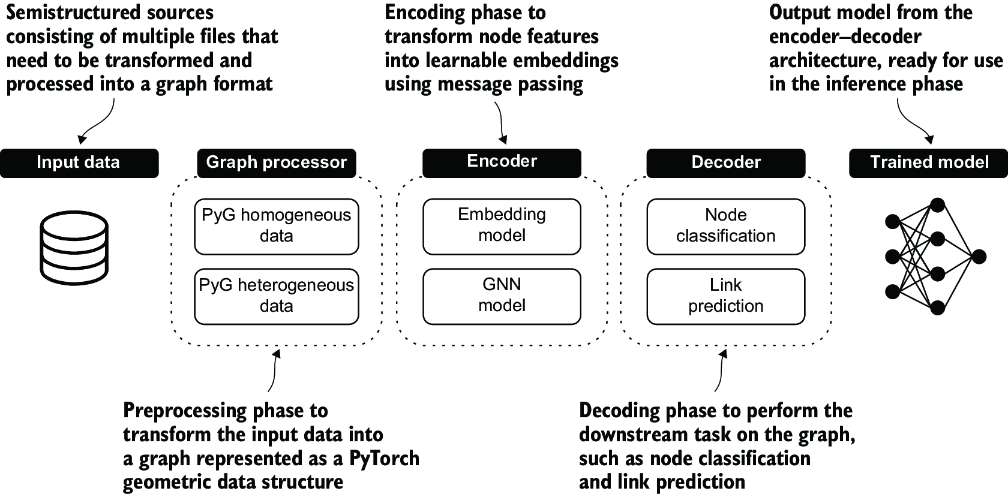
Use the end-to-end framework to trace graph construction, GCN encoding, task-specific decoding, training, and inference. section 12.0



