A Grover iterate, or Grover operator, is one repeatable amplification step in quantum search. It applies an oracle that tags desired outcomes by multiplying their amplitudes by −1, then applies an inversion operator that raises the magnitudes of tagged outcomes while lowering those of untagged outcomes. Repeating the iterate makes desired measurement outcomes more likely. section 6.1.4 section 6.3
Magnitude amplification starts by preparing a state with an operator A, then applies G a chosen number of times: GjA. The iterate is tied to the prepared state because its inversion operator corresponds to that state. In circuit form, the general construction is G = AM0A−1O, with O as the oracle and M0 as the inversion about the zero state. section 6.1 section 6.2.3
Figure 6.16 Circuit diagram of the magnitude amplification procedure GjA, where g consists of an oracle O and the inversion operator M
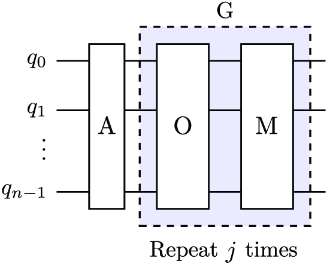
Use the circuit diagram to separate state preparation A from the repeated block G, whose oracle precedes inversion. section 6.1.4
Implement one iteration as a reusable circuit-building pattern:
- Accept an oracle O and a state-preparation operator A for the same number of qubits. section 6.2.3
- Append O first so desired outcomes are tagged. section 6.2.3 section 6.3
- Append the inversion circuit derived from A to complete the iterate. section 6.2.3
- Repeat the completed G block rather than rebuilding search logic for every iteration. section 6.1.4
Three-qubit search for outcome 3
Prepare a uniform three-qubit state, mark outcome 3 with a predicate, and apply the classical Grover procedure. After one iteration the good outcome’s amplitude increases; after two it increases further. Assertions compare the simulated state with the expected amplitude for the selected iteration count. section 6.1.4 section 6.1.4
The number of iterations matters. For a uniform state with n qubits and L good outcomes, a suggested count uses floor(π/4 √(2n/L)); the ideal count depends on how many outcomes the oracle specifies, which may not be known. Amplifying amplitudes alone is not the advantage: measurement and an efficient oracle are essential to an effective search procedure. section 6.1.4 section 6.2 section 10.2
Search encoded function values
Construct an oracle over a value register, then use it in a Grover operator to search an encoded function. For f(k) = k + 1 on two key qubits, an oracle matching a leading value bit of 1 identifies outputs at least 4; after one iteration, the matching key–value pair has magnitude 1. section 10.2

