The Hadamard, or H, gate remixes a single qubit’s two amplitudes. For state [a, b], it produces [(a + b)/√2, (a − b)/√2]. Think of it as computing scaled sum and difference channels rather than merely flipping a bit. The √2 scaling preserves the total probability represented by the pair. section 3.2.2
Figure 3.19 The general form of the effect of the H gate on a pair of amplitudes
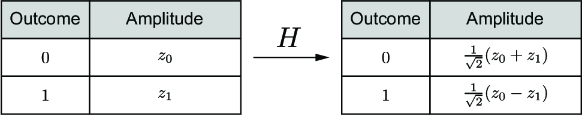
The amplitude-pair diagram makes the H gate’s sum-and-difference recombination visible. section 3.2.2
Starting from the default single-qubit state, H gives both outcomes equal amplitude magnitude and therefore equal probability: a uniform two-outcome distribution. A simulator can apply it directly with transform(state, h), then inspect amplitudes or sample outcome frequencies. section 3.4.1 section 3.2.2
Prepare a uniform three-qubit state
Apply H once to every qubit of a default three-qubit register. Each gate recombines amplitude pairs that differ at its target position; after all three gates, all eight outcomes have equal real amplitudes and equal probability. q = QuantumRegister(3) qc = QuantumCircuit(q) for i in range(len(q)): qc.h(q[i]) state = qc.run() section 4.3.4 section 4.5.3
H is also an interface between phase and measurement-visible magnitudes. After phase encoding, another H can translate a phase difference into amplitudes with magnitudes cos(θ/2) and sin(θ/2), allowing sampled outcome frequencies to reveal the encoded angle. section 7.2
This role recurs in quantum Fourier transform workflows: Hadamards help recover binary digits from phase shifts in an inverse QFT, and prepare equal-magnitude amplitudes before phase gates encode a geometric sequence. section 7.4.1 section 8.2

