liveBook · Manning

Hadamard gate

As explained in Quantum Programming in Depth

The Hadamard gate is a single-qubit quantum gate that creates equal superpositions from computational-basis states.

The Hadamard gate switches between the computational basis and the Hadamard basis. In unitary-identification experiments, this basis change can transform an X gate into a Z gate and make measurement-based distinction possible. section 5.1.1

Distinguishing X from H

Prepare a qubit in |0⟩, apply the unknown gate, apply X, and apply the unknown gate again. If the unknown gate is X, the sequence is XXX = X; if it is H, the sequence is HXH = Z. Measuring the final qubit yields 1 for X and 0 for H. section 5.1.1

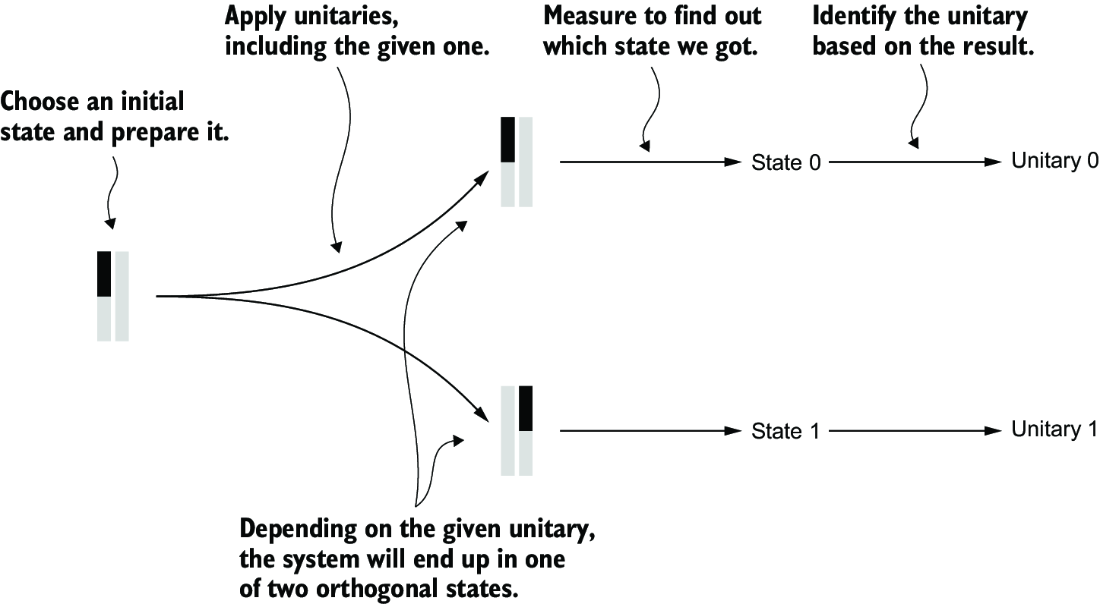
Figure 5.2 To distinguish two unitaries in one experiment, we need to choose an initial state that can be converted to different orthogonal states by applying each of these two unitaries, possibly as part of a longer sequence of unitaries. We then run the experiment by preparing that initial state, applying that sequence of unitaries, and identifying which of the orthogonal states we got using measurements.
figure

Use the figure to connect unitary discrimination with state preparation, gate sequences, orthogonal outputs, and measurement. section 5.1.1


How Quantum Programming in Depth covers it

How deep it goes
Explains basis conversion through a concrete gate sequence and measurement, without developing implementation code or broader gate theory.
Examples
Demonstrates the sequence XXX versus HXH and identifies the unknown gate through final measurement results.
What it assumes
Assumes familiarity with computational-basis states, unitary gates, Pauli X and Z gates, and quantum measurement.
What you can do after
Apply the Hadamard gate within a sequence that distinguishes X and H using one qubit and measurement.
How it connects
Connects the Hadamard gate with computational basis, Hadamard basis, Pauli X, Pauli Z, unitary operations, and measurement.

Also explained in

Compare how 2 books explain Hadamard gate →

Related concepts

This explainer was generated by Manning's knowledge graph from the text of Quantum Programming in Depth. The section links point to the parts of the book it draws on.