A happy path is a positive scenario in which valid inputs and expected conditions lead to a successful outcome without exceptional behavior. It provides a practical starting point for testing critical workflows before expanding coverage. section 14.1.4
Establish a minimal steel thread by choosing the simplest successful route through each critical workflow:
- Sign up with valid traveler details using an email-based registration flow. section 14.1.4
- Sign in with valid authentication credentials, avoiding validation failures. section 14.1.4
- Search for a one-way, direct, economy flight that can be booked. section 14.1.4
- Record the expected consequence of each scenario, rather than merely reproducing current system behavior. section 14.1.5
Contrast the two paths
A valid registration should create an account and allow sign-in. An invalid registration is an unhappy-path variation: validation should prevent account creation and explain how to correct the submitted details. Treating both outcomes explicitly exposes the difference between successful behavior and error handling. section 14.1.5
Figure 14.7 Establishing a steel thread of simplest possible scenarios required to accomplish a given goal
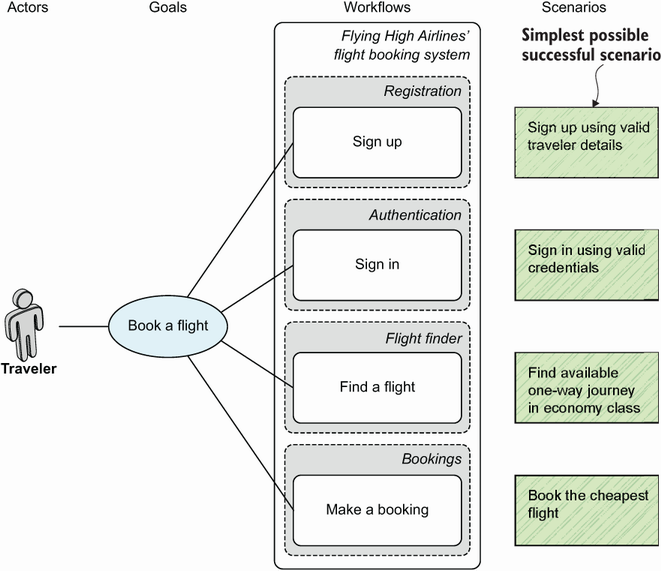
Use the steel-thread visualization to keep the initial journey focused on the fewest successful scenarios needed to accomplish a goal. section 14.1.4



