The happy path is the ideal execution flow: inputs arrive as expected, dependencies work, and every operation succeeds. It feels like coding on a laptop where the database is always online and an API responds instantly. section 10.1
Production is less cooperative. Networks drop packets, services go down, and traffic can spike. Code that works only when everything behaves perfectly can fail hard once deployed. section 10.1
A payment request built around the happy path can fail in several ways:
- Without a timeout, a frozen API can leave a request waiting indefinitely. section 10.4.1
- Without retries, a brief network glitch can turn a temporary failure into a failed purchase. section 10.4.1
- Without a fallback, an unavailable payment service can block the purchase instead of preserving the order for later. section 10.4.1
- Without an idempotency key, a lost success response can prompt a second click and a duplicate charge. section 10.4.1
Figure 10.1 The "Happy Path" vs. Cloud Reality: Why assuming a perfect network is the most dangerous mistake an architect can make.
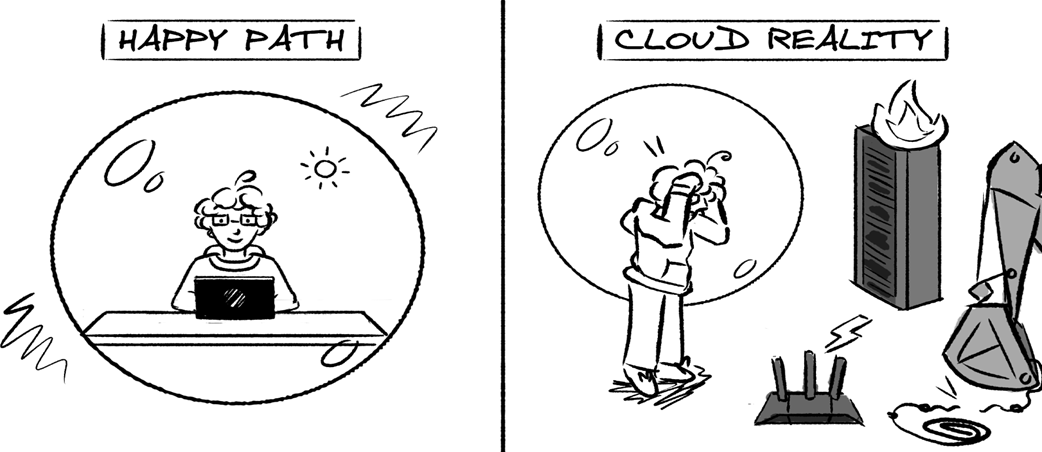
Compare the ideal network assumed by the happy path with the failures cloud systems face. section 10.1





