A hardware security module (HSM) is a dedicated cryptographic device that stores secret keys and performs cryptographic operations while making physical attacks more difficult. Think of it as a larger, faster secure element for enterprise servers: usually a rack-mounted device or PCIe card in a data center, though small USB devices such as the YubiHSM also exist. section 13.2.3 section 13.3
An HSM’s role becomes clearer through its surrounding choices:
- It commonly exposes cryptographic operations through PKCS#11 rather than a universal HSM-specific interface. section 13.5
- It occupies the enterprise end of a hardware-security range: smart cards and secure elements are smaller, while TPMs and TEEs serve different integration points. section 13.3
- Certification levels communicate resistance claims rather than magical invulnerability: FIPS 140-3 levels range from no physical-attack protection at level 1 to secret wiping after intrusion at level 3. section 13.2.3
- Hardware alone is not enough; timing, power, electromagnetic, and fault attacks can still require software mitigations such as constant-time algorithms, blinding, and masking. section 13.5
A data-center deployment
An enterprise server can use an HSM installed as a PCIe card, such as an IBM 4767, or connect to an external rack-mounted unit. A small deployment might instead use a USB YubiHSM. The choice depends on required form factor, cryptographic throughput, and security level. section 13.2.3 section 13.3
Figure 13.2 An IBM 4767 HSM as a PCI card. Photo from Wikipedia (http://mng.bz/XrAG).
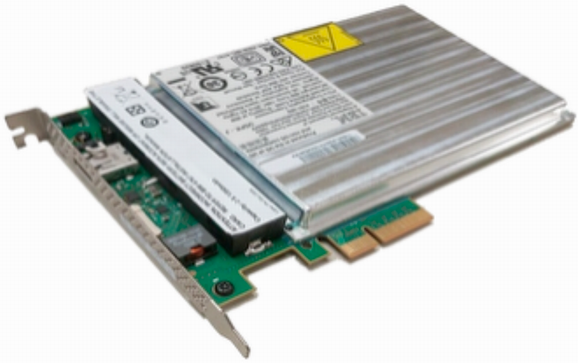
Use the figure to visualize an HSM as a physical PCI card attached to an enterprise server. section 13.2.3

