Headroom is spare system capacity that absorbs demand spikes and variation in processing time before service degrades. Without enough margin, a brief surge can trigger cascading timeouts. section 12.5.2
Use headroom to assess whether a system can keep up and absorb variation:
- Compare actual throughput with current demand. A headroom factor of 2.0 means capacity for twice the current load; below 1.0 means the system is falling behind. section 11.6.1
- Treat a factor below 1.25 as a warning that a slow dependency could cause missed takt. Track the metric continuously because demand and processing time change. section 11.6.1
- For critical services, a 60–80% utilization target leaves room for variation. Uneven demand calls for more headroom than leveled demand. section 12.5.2
Processing time versus takt
With a 600 ms takt and 1,050 ms processing time, one pipeline cannot keep up; two are needed just to meet demand. At 153 ms, one worker handles peak demand with nearly four times the headroom. section 11.6.1
Figure 12.10 Headroom determines whether a traffic surge is absorbed or becomes a cascade.
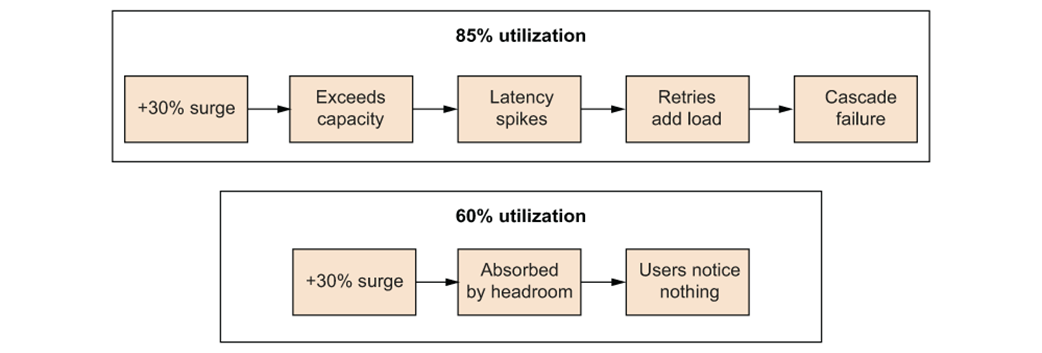
See how limited headroom can turn a traffic surge into a cascade. section 12.5.2



