A heterogeneous graph contains multiple node types, edge types, or both. It models richer networks than a homogeneous graph, where every node and edge shares one type. section 1.2.2
Use the model when the network’s entities and relationships carry different meanings:
- Represent recruitment with candidate and company nodes, plus candidate relationships and employment edges. section 1.2.2
- Distinguish relationship semantics instead of collapsing every connection into one generic edge type. section 1.2.2
- Treat a bipartite graph as a specialized heterogeneous graph when nodes divide into subsets and connect only across subsets. section 1.2.2
Figure 1.2 A homogeneous graph and a heterogeneous graph. Here, the shade of a node or edge represents its type or class. For the homogeneous graph, all nodes are of the same type, and all edges are of the same type. For the heterogeneous graph, nodes and edges have multiple types.
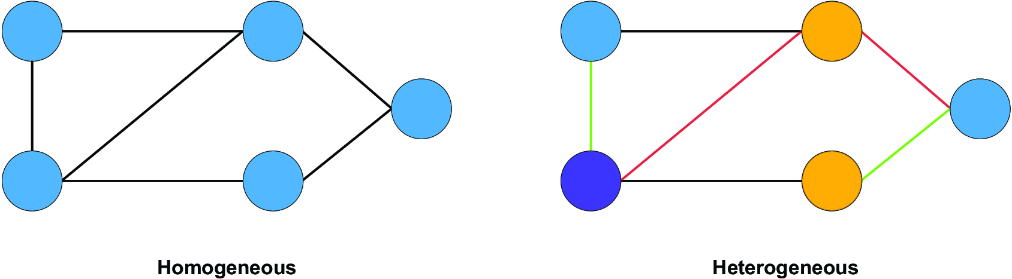
Compare uniform and typed networks visually: node and edge shades indicate their types. section 1.2.2


