A heterogeneous graph contains multiple node types or relationship types. Unlike a homogeneous graph, it preserves distinctions between entities and connections, making it suitable for knowledge graph completion and other typed-link prediction tasks. section 11.0 section 11.4
Key modeling characteristics include:
- Represent directed facts as triples containing a head entity, relation, and tail entity. section 11.4
- Allow several relationship types between the same entity types and distinguish those types during prediction. section 11.0 section 11.4
- Support knowledge graph embeddings that encode both nodes and relationships rather than nodes alone. section 11.4
Drug repurposing
A biomedical graph can connect existing drugs with known treatments and represent additional entity and relationship types. Knowledge graph completion then predicts missing drug–treatment links, which domain experts evaluate before clinical trials. The predictions prioritize candidates rather than approving new uses automatically. section 11.0 section 11.4
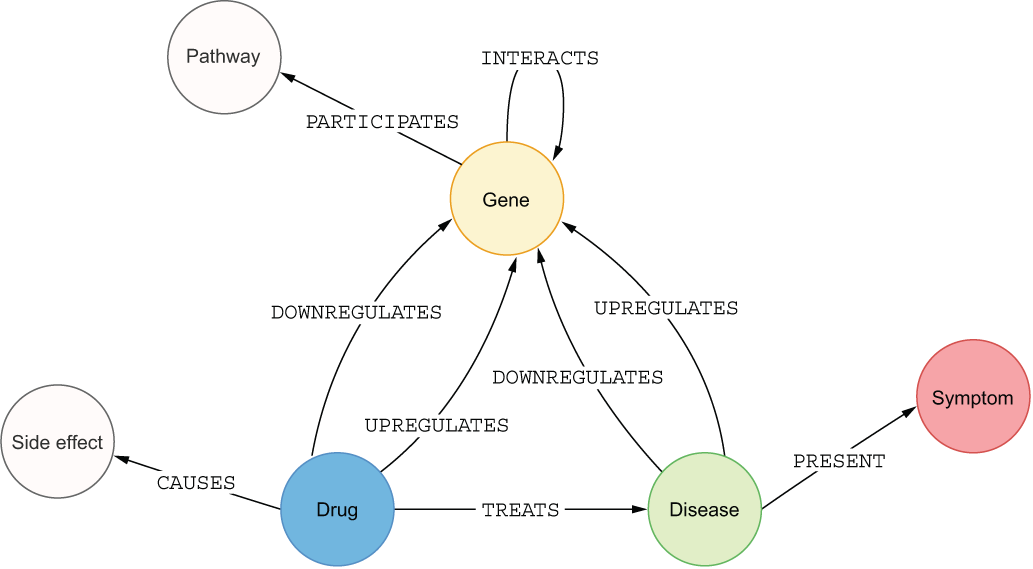
Use the complex biomedical graph schema to inspect how multiple entity and relationship types can coexist in one graph. section 11.0


