A heuristic is a straightforward, less computationally intensive rule or procedure that produces an outcome without a machine-learning model. It is often the first implementation to try when engineering complexity, delivery timelines, or interpretability matter. section 1.5
Use heuristics as practical baselines when:
- A simple algorithm or business rule can satisfy the feature without the overhead of a full-scale model. section 1.5
- An eventual machine-learning model needs a baseline that it should exceed on relevant product metrics. section 1.5
- Offline evaluation can measure the heuristic, but the metric must match the job the algorithm performs. section 1.5 section 1.3
“Your Recent Shows”
A streaming app can compute a row of previously watched TV shows with simple retrieval and filtering logic. Because the goal is to display the user’s complete watch history rather than predict preferences, recall is an appropriate offline metric: low recall signals omissions or possible bugs. section 1.3
Figure 1.4 Differing offline metrics for each recommendation scenario. The Dramatic Yet Light Movies recommendation model uses Precision at K (P@K) to ensure that the top movies in the list are highly relevant movies for the user. The Your Recent Shows model relies on recall as the metric to optimize in an offline setting, as it focuses on ensuring the system retrieves all relevant past TV shows to give customers a complete and personalized experience.
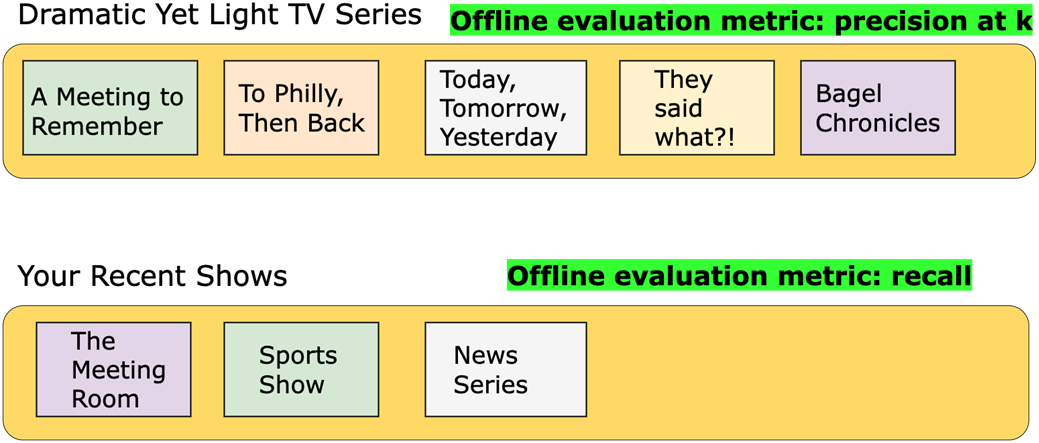
Compare how recommendation scenarios select offline metrics: precision at K supports ranked relevance, while recall supports complete retrieval of prior shows. section 1.3











