Actual state is the configuration state an API system currently has in operation, such as the deployed configuration of an API gateway. It can diverge from the desired state stored in an environment repository, creating drift. section 1.5.6 section 9.4.1
Manage actual state through a reconciliation workflow:
- Store the desired configuration declaratively in a version-controlled repository with immutable history, access controls, and review. section 9.4.1
- Use software agents or deployment pipelines to pull the desired declaration and observe the running system. section 9.4.1
- Detect drift when actual state differs from the desired declaration, then update the running system to restore the match. section 1.5.6
- Avoid direct gateway-UI changes; use Git pull requests so changes remain auditable and can be reverted. section 1.5.6 section 9.4.1
Gateway configuration drift
An engineer changes an API gateway through its administration UI, while the environment repository still declares the previous configuration. An agent detects the divergence and redeploys the repository’s desired state, restoring the actual state. section 1.5.6
Figure 1.4 APIOps is based on the GitOps approach of having the desired configuration state of the API gateway, and services are defined declaratively in an environment repository in Git. Dev teams make all changes to the desired system state via Git, and operations teams can review and approve. Software agents automatically detect any difference between the deployed state and the desired state (as defined in the environment repository). If the agent detects a drift, it automatically deploys the desired state to the specified environment so the actual state matches.
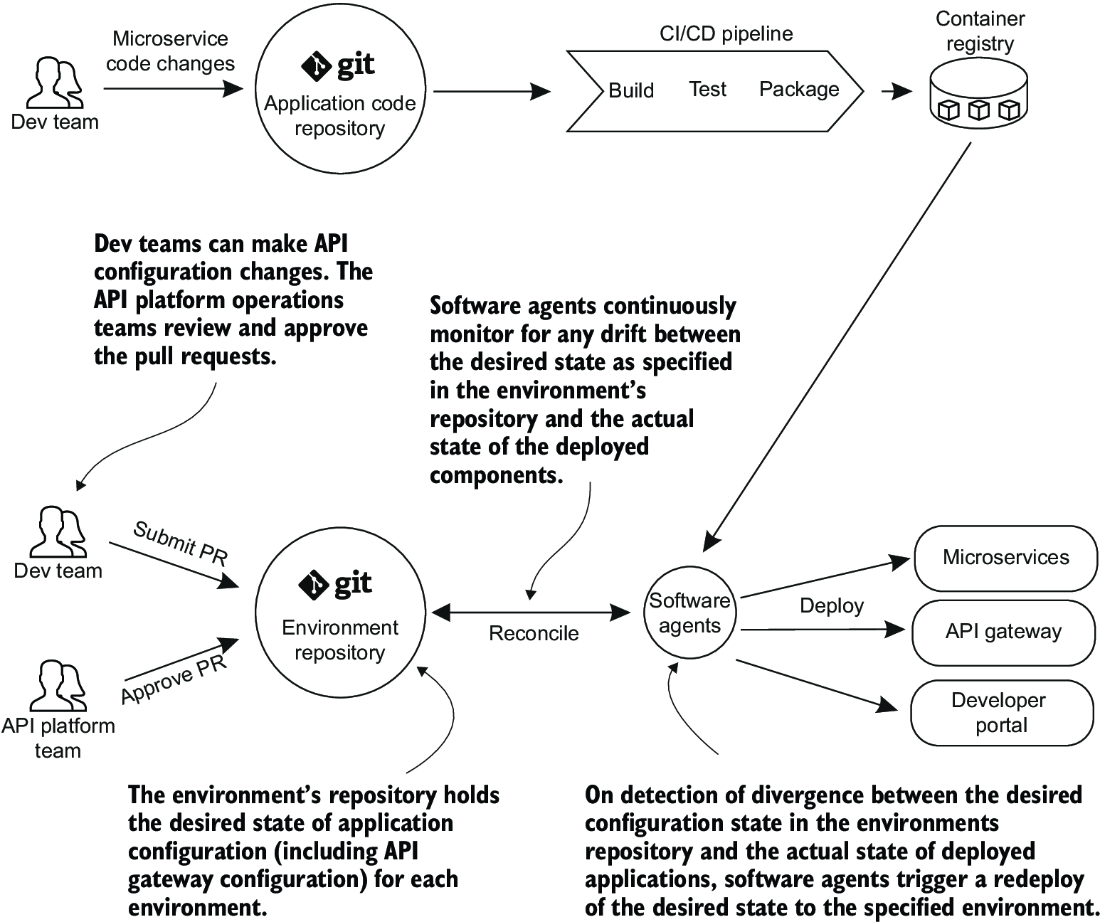
Trace how Git-based declarations, review, automated detection, and redeployment keep API gateway and service configuration aligned. section 1.5.6






































