liveBook · Manning

Endpoint

As explained in Machine Learning Platform Engineering

An API endpoint is a network-accessible interface that receives requests and returns responses according to an API contract.

An API endpoint exposes a model through a network-accessible interface: it receives requests and returns responses. In production ML systems, endpoints serve real-time predictions and fit within broader deployment workflows. section 2.1.5 section 6.1.3

Common model-serving endpoint roles include:

  • The income classifier’s /predict endpoint accepts a request and returns a prediction. section 6.1.3
  • BentoML also exposes /metrics for Prometheus scraping; MLflow model servers provide /health and /invocations endpoints. section 6.1.3 section 10.7
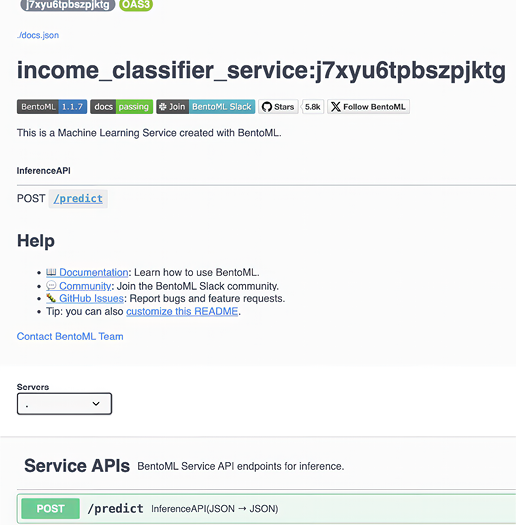
Figure 6.10 Swagger document for the deployed service with the /predict endpoint
A screenshot of a computer

AI-generated content may be incorrect.

The Swagger document shows the deployed service’s /predict endpoint. section 6.1.3

How Machine Learning Platform Engineering covers it

How deep it goes
Traces deployment from application packaging through ingress, prediction requests, and metrics.
Examples
Uses an income classifier’s /predict endpoint and MLflow’s /health and /invocations endpoints.
What you can do after
Operate/configure model-serving endpoints with BentoML and Yatai or MLflow, and inspect requests, health, and metrics.
How it connects
Connects model endpoints with REST APIs, BentoML, Yatai, Kubernetes, Prometheus, and MLflow.

Also explained in

Compare how 26 books explain endpoint →

Related concepts

This explainer was generated by Manning's knowledge graph from the text of Machine Learning Platform Engineering. The section links point to the parts of the book it draws on.
























