Think of a server as the kitchen behind a burger counter: a client asks, and the server checks the order, does the work, and returns a result. A server application handles responsibilities such as business logic, data storage, security, and integrity, regardless of whether the request comes from a browser, a mobile app, or another server. section 6.2.2
The client and server communicate across a network boundary using an API contract. That separation lets teams specialize and add servers as demand grows, but network calls introduce latency and the possibility of failure. section 6.2 section 6.2.5
Figure 6.10 The client and the server never touch directly; they use the contract as the middleman!
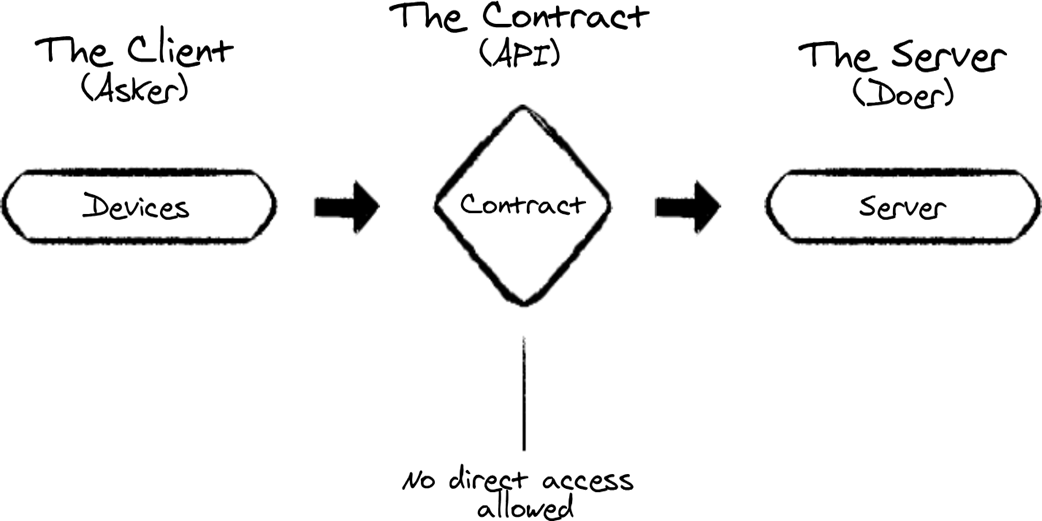
The diagram places the API contract between the client and server: each side exchanges messages according to the same rulebook. section 6.6
A request and a reply
A client sends GET /user/123 and waits. The server processes the request and might return 200 OK with {"name":"Archie"}; the client then updates its display. For longer work, the server can instead return a 202 Accepted receipt while processing continues in the background. The synchronous exchange ends, but the work is not necessarily finished. section 6.2.3
How much work belongs on each side? A thin client leaves most rendering and formatting to the server, but interactions can feel slow when each needs a network round trip. A thick client can provide immediate feedback and work offline, but adds complexity and can duplicate logic. A practical compromise is to check email format on the client while keeping the decision about whether an email may register on the server. section 6.2.4
Server can also mean the machine or environment running the application. Traditional physical servers were costly to acquire and maintain, encouraging teams to treat them as individual “pets.” An immutable-server approach instead avoids undocumented changes to a live server by replacing it when changes are needed, making server state more predictable. section 9.3 section 9.8.1













