Suppose you want to estimate the proportion of people who prefer tea. Before surveying anyone, you need a way to express what proportions you consider plausible. A hyperparameter controls the shape of that prior distribution; it is not the unknown proportion you are trying to estimate. section 3.7
For a beta prior, two hyperparameters, α and β, can express different beliefs about a proportion between 0 and 1. Beta(1, 1) is flat: it gives no part of the range a higher density than another. Choosing Beta(0.5, 0.5) instead favors proportions near the extremes. The choice matters because the posterior reflects both the prior and the observed data. section 3.7 section 3.9
Update a tea-preference prior
Start with Beta(1, 1). If 3 of 5 people surveyed prefer tea, add the 3 successes to α and the 2 other responses to β. The result is Beta(4, 3). The numbers have changed, but the distribution remains in the beta family—a convenient property of the beta–binomial conjugate pair. section 3.7 section 3.18
Figure 3.3 Comparison between the posterior distributions of 𝑝 under different prior distributions.
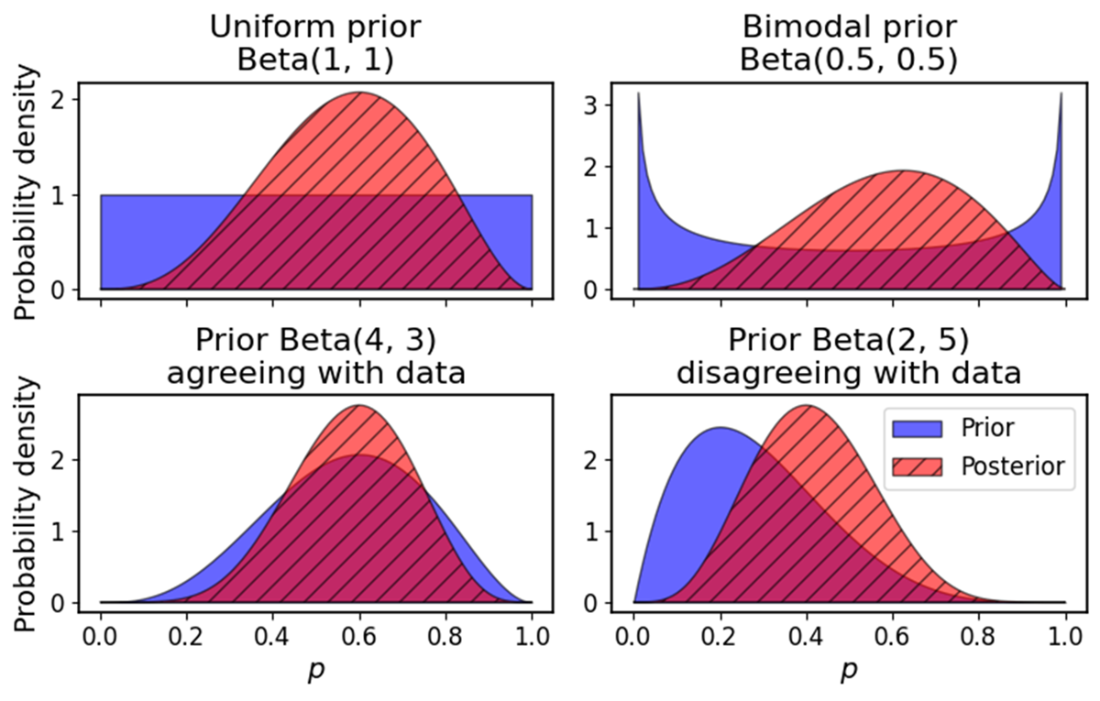
Compare how different beta hyperparameters change the prior and, after the same data, the posterior. section 3.9
Hyperparameters also describe priors for real-valued quantities. A normal prior for the slope relating house area to price uses a mean for its central estimate and a standard deviation for its spread. A mean of 100 and standard deviation of 100 express a $100-per-square-foot estimate with substantial uncertainty. After observing prices and areas, updated values describe a posterior that is more concentrated and centered near 200. section 3.12 section 3.14
The term can also name a user-chosen control outside a prior distribution. In an upper confidence bound decision rule, β sets how strongly uncertainty counts alongside mean utility: a larger β favors exploration more. Check what a hyperparameter controls before interpreting it. section 12.10

























