Hyperparameter tuning selects training settings that balance specialized adaptation against instability, resource use, and loss of foundational knowledge. It is especially important during fine-tuning, where domain constraints magnify the effect of each choice. section 1.4.2
Tune the settings together rather than in isolation:
- Learning rate controls adaptation speed; higher values learn faster but can destabilize training or erode existing knowledge. section 1.4.2
- Batch size affects update stability, efficiency, compute requirements, and final performance; gradient accumulation can approximate larger batches through smaller steps. section 1.4.2
- Training epochs require control to avoid overfitting, where memorized examples fail to generalize; early stopping provides an automated safeguard. section 1.4.2
Figure 1.7 Task-specific fine-tuning process. Pretraining creates a base model that is then further trained to perform multiple, more complex tasks, such as summarization, classification, and code or text generation.
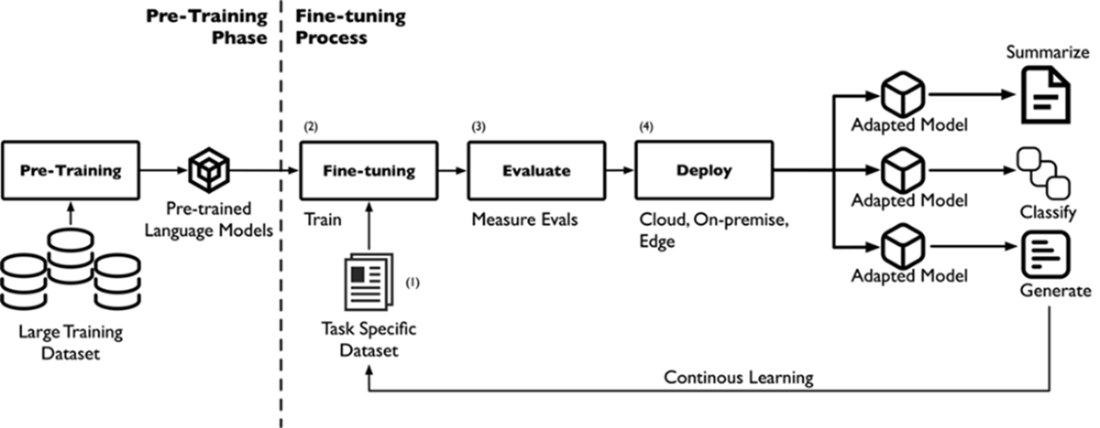
Situates tuning within task-specific fine-tuning from a pretrained base model toward summarization, classification, and generation tasks. section 1.4.2