liveBook · Manning

Hyperplane

As explained in Grokking Machine Learning

A flat geometric subspace of one dimension less than its surrounding space that can separate points in higher-dimensional space.

A hyperplane is an (n−1)-dimensional flat boundary in n-dimensional feature space. It divides that space into two regions, which a perceptron uses for its two class predictions. In two dimensions, the boundary is a line; in three, it is a plane. section 5.1

Sentence features

Represent a sentence by its word counts: with three words, a sentence containing them 5, 8, and 3 times is a point in three-dimensional space. A classifier’s plane divides such points into two regions. section 5.1

Figure 5.10 A dataset of sentences with three words is plotted in three dimensions. The classifier is represented by a plane that splits the space into two regions.
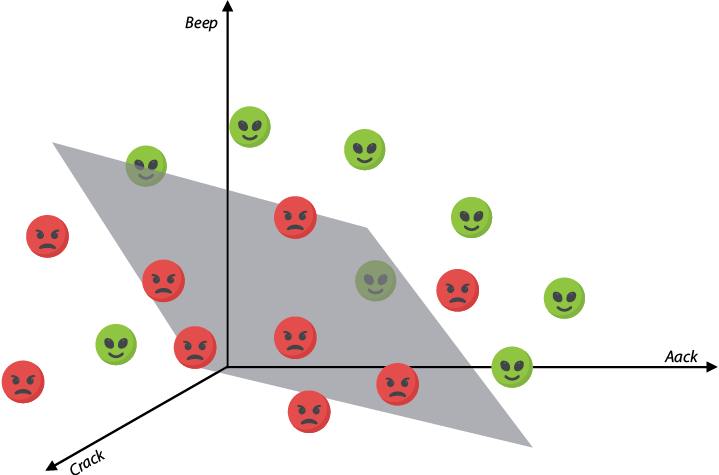
See how a plane divides a three-dimensional dataset of sentence points into two regions. section 5.1


How Grokking Machine Learning covers it

How deep it goes
Explains the dimensional analogy and classification boundary through weighted features, without a formal geometric derivation.
Examples
Uses alien sentences represented by word counts, including a three-feature point and a separating plane.
What you can do after
Understand how a perceptron uses a boundary to divide higher-dimensional feature vectors into two classes.
How it connects
Connects hyperplanes to perceptrons, feature vectors, weights, bias, and binary classification.

Also explained in

Compare how 6 books explain hyperplane →

Related concepts

This explainer was generated by Manning's knowledge graph from the text of Grokking Machine Learning. The section links point to the parts of the book it draws on.



