A hyperplane is a flat boundary with one fewer dimension than its surrounding space: a line in two dimensions, a plane in three, and a higher-dimensional separator in a feature space. It can be written as w^T x + b = 0, where w determines orientation and b determines position. section 2.8.2 section 7.3.2
The vector w is normal to the hyperplane. For any two points on it, their difference is perpendicular to w, because the dot product is zero. Evaluating w^T x + b gives the boundary’s side: zero means on the hyperplane, a negative value means one region, and a positive value means the other. section 7.3.2 section 7.2.2
In machine learning, hyperplanes support:
- Linear classification by partitioning feature space into two half-spaces. section 7.6
- Decision boundaries whose orientation and position depend on the learned weights and bias. section 7.2.2
- Approximation of more complicated boundaries after transforming inputs or combining perceptrons in multilayer networks. section 2.8.2 section 7.6
Stock buy-versus-no-buy classifier
Represent each stock with momentum, dividend, and volatility. A plane separates buy from no-buy points in three-dimensional feature space: higher volatility can require higher momentum, while higher dividends can reduce the required momentum. With more input variables, the plane becomes a hyperplane. section 2.8.2
Figure 2.10 The normal to the plane is the same at all points on the plane. This is the fundamental property of a plane. n̂ depicts that normal direction. Let  0 be a point on the plane. All other points on the plane, depicted as , will satisfy the equation (−0) ⋅ n̂ = 0. This physically says that the line joining a known point 0 on the plane and any other arbitrary point on the plane is at right angles to the normal n̂. This formulation works for any dimension.
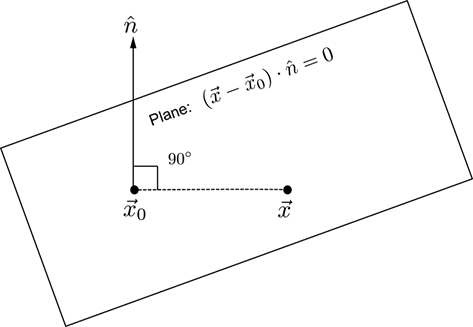
Visualizes the constant normal direction and the perpendicular relationship between the normal vector and every line lying on the hyperplane. section 2.8.2





