A hyperplane is a flat boundary one dimension lower than its ambient space: a point in one dimension, a line in two, and a plane in three. In classification, it can separate classes in a feature space. section 8.1.2
For feature vector x, weight vector w, and bias b, the decision function f(x) = wᵀx + b defines a hyperplane where f(x) = 0. The weight vector is perpendicular to the boundary; the bias shifts its position. The sign of f(x) identifies which side contains an observation. section 8.2.1
Temperature features
A single temperature feature cannot separate safe observations in the middle from unsafe observations at both extremes. Adding temperature squared creates a two-dimensional feature space where a straight-line hyperplane can separate them. That separator demonstrates possible separation, not the maximum-margin boundary. section 8.1.2
In a hard-margin SVM, the separating hyperplane is positioned midway between parallel margin boundaries, with support vectors constraining the widest possible margin. A kernel can instead make the hyperplane linear in a transformed feature space, so its boundary may appear curved in the original space. section 8.2.3 section 8.6.2
Figure 8.3 Mapping each temperature reading into a two-dimensional feature space defined by temperature and temperature squared makes the classes linearly separable. The points are schematic rather than exact functional values. The dashed line is a hyperplane separating the safe observations, shown as circles, from the unsafe observations, shown as squares. It demonstrates possible separation, not the optimal maximum-margin boundary.
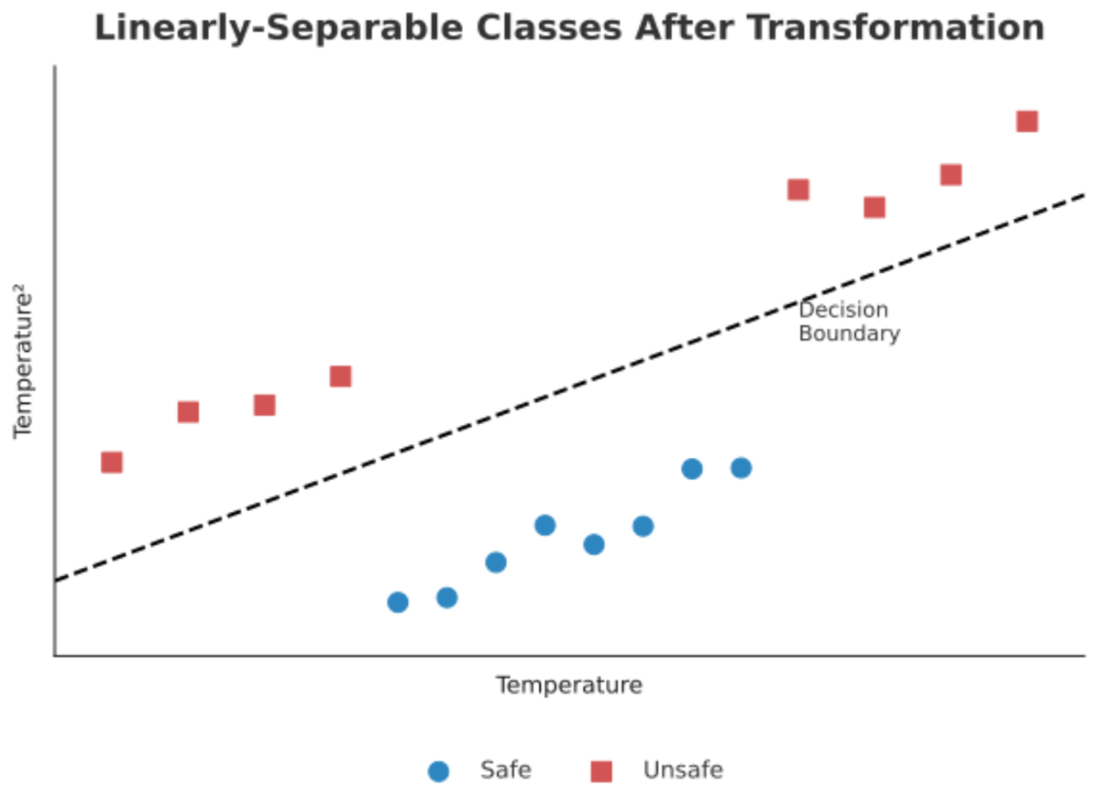
The figure contrasts the original temperature axis with a transformed feature space, where a dashed hyperplane separates the classes. section 8.1.2







