Image segmentation divides an image into multiple segments—sets of pixels representing objects, regions, or boundaries. For document fraud, it assigns each receipt pixel to one of two classes: forged or genuine. section 6.2
Segmentation is preferred over whole-image classification because it:
- Pushes the model toward forgery regions instead of allowing shortcuts such as language differences between forged and genuine receipts. section 6.2
- Produces pixel-wise detections that make the model’s decision easier to interpret. section 6.2
- Uses a CNN-based model such as DeepLabV3; atrous convolutions help capture more image context. section 6.2
Receipt forgery heatmaps
Resize a receipt to 256×256 pixels, run model inference, and obtain a forgery probability between 0 and 1 for every pixel. Resize the output to the original image dimensions and overlay it as a heatmap alongside ground-truth bounding boxes. Training heatmaps may align closely with known forgeries, while test heatmaps can reveal overfitting through misplaced or consistently high-probability regions. section 6.3.5
Figure 6.7 Example of image segmentation, where the original image is shown on the left, and its segmentation output is shown on the right. Different segments in the segmentation output refer to different entities in the original image, namely the beach background, the person’s hair, arms, dress, face, and so on.
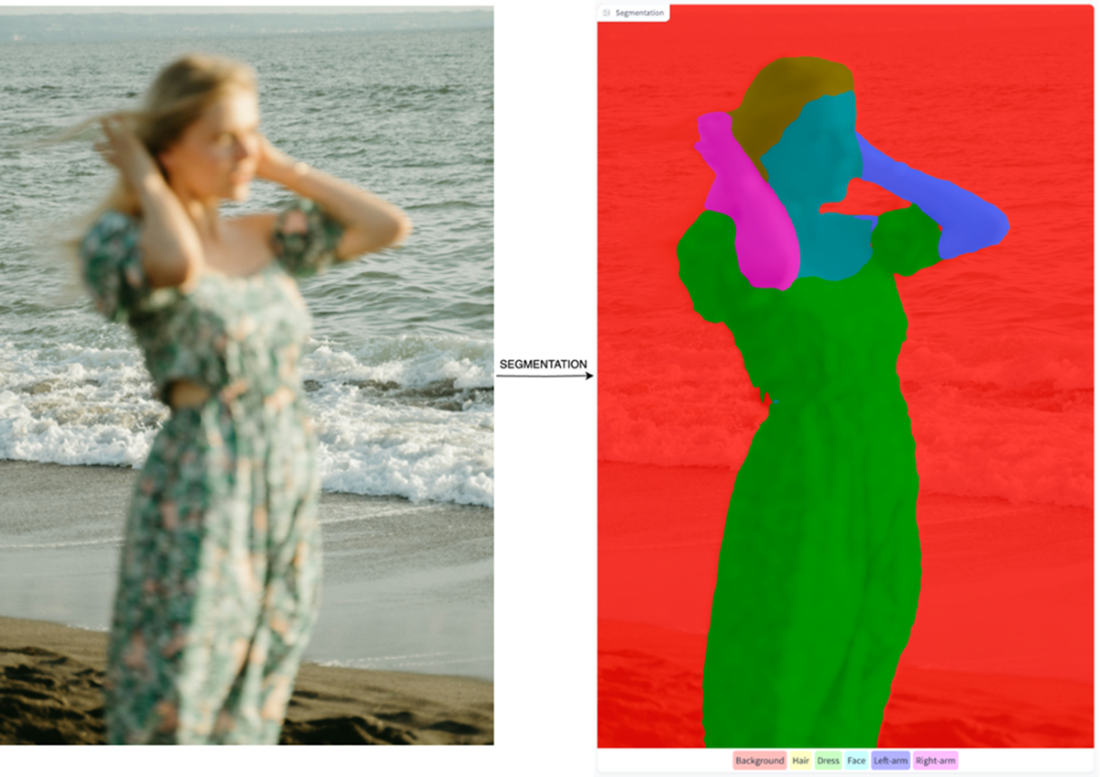
Compare an original beach photograph with its segmentation into background, hair, dress, face, and arms. section 6.2






