Impact mapping is a visual mind map built through stakeholder and delivery-team conversations. It connects business goals, affected actors, behavior changes, and software or other deliverables, while making assumptions visible. section 4.3 section 4.3.5
Build the map by discussing five connected questions:
- Pain point: What business problem are we solving, and how can we measure it? section 4.3
- Goal: What do we aim to improve, and by how much? section 4.3
- Actor: Whose behavior could help or hinder the goal? section 4.3
- Impact: What behavior change would help achieve the goal? section 4.3
- Deliverables: What features or initiatives could support that behavior change? section 4.3 section 4.3.5
Use the map to prioritize capabilities and features against expected outcomes rather than accepting a fixed feature list. Treat it as a living document: release deliverables, measure results, test assumptions, and update the map and short-term plans when evidence changes. section 3.2.2 section 4.3.5
Commuter rail service
A team separates commuters from tourists because commuters dominate the expected outcomes. It identifies easier daily trip planning and coping with delays as capabilities, then considers route optimization, favorite-trip recording, and real-time train times as candidate features. A delay notification is valuable because it enables travelers to change plans; station ratings are less valuable because they offer little actionable help to someone running late. section 3.2.2
Figure 4.5 What can you do to encourage or allow the stakeholders to modify their behavior to help achieve the business goal?
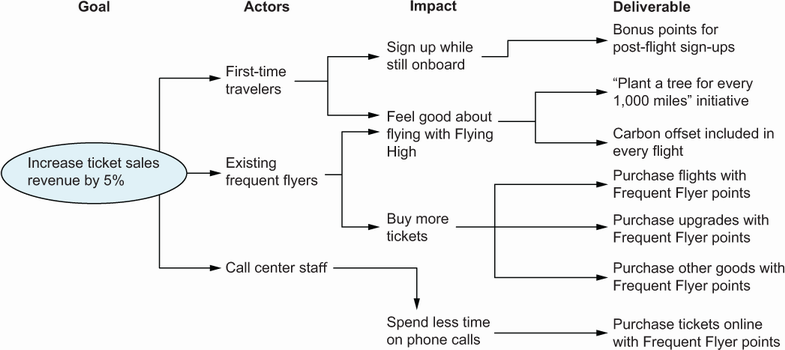
Use the impact-map figure to inspect how goals, actors, behavior changes, and deliverables are arranged as one visual conversation. section 4.3


