Implicit feedback is preference information collected automatically from behavior rather than directly supplied by users. Clicks, purchases, watch time, and skips provide abundant signals, but each interaction can be noisy: a click does not necessarily mean the user liked the item. section 1.3
Use implicit feedback as behavioral data inside a recommender feedback loop:
- Recommendations generate exposure, users interact with items, interactions are logged, and the resulting data trains later recommendations. section 1.3
- Treat observed interactions as positive evidence when appropriate, while recognizing that non-interaction and low engagement may have several interpretations. section 3.3.4
- Prefer raw clicks, watch time, and purchases in production; use explicit ratings as a proxy only when behavioral events are unavailable. section 3.3.4
Converting ratings for implicit ALS
MovieLens provides explicit ratings from 1 to 5 stars. Keep ratings of 4 or 5 as positive interactions, store the original rating as a confidence value, and replace the rating with 1. This converts preference strength into binary feedback while retaining some distinction between four- and five-star evidence. The conversion discards information and is unnecessary when raw behavioral events already exist. section 3.3.4
Figure 1.6 The recommender system feedback loop. Users receive recommendations, interact with content (clicks, purchases, views), interactions are logged, this data trains models, and improved models generate better recommendations.
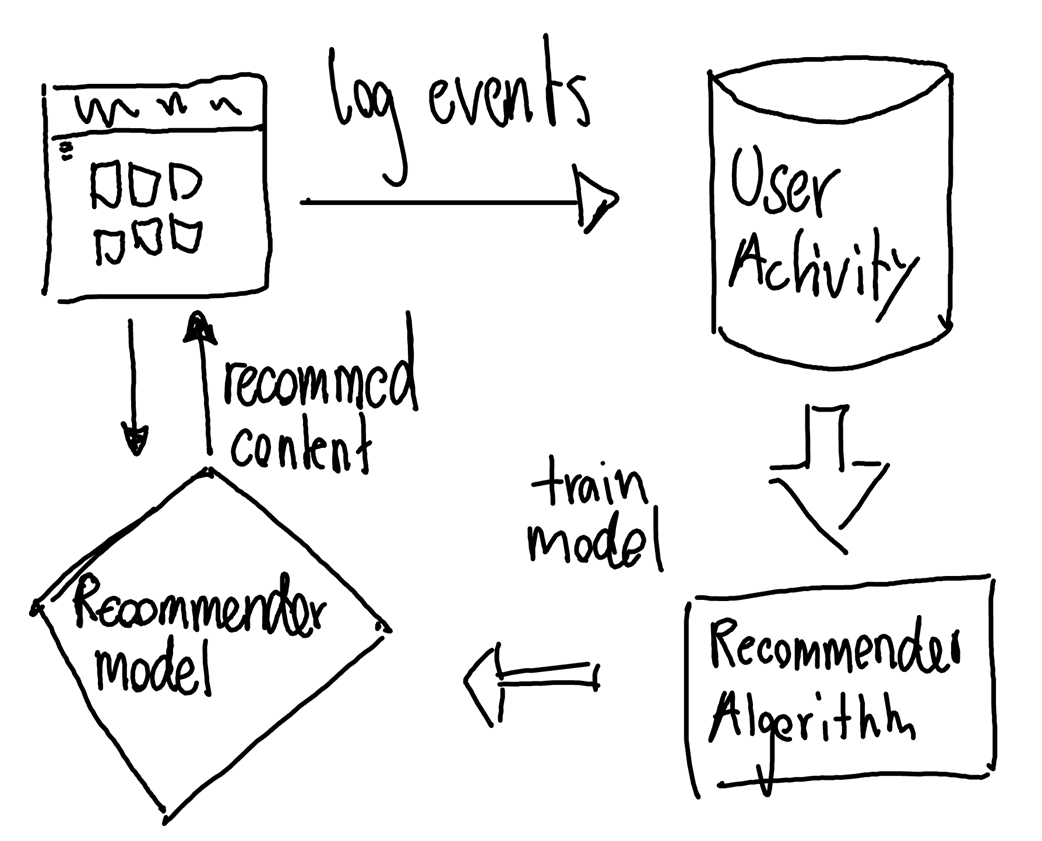
The feedback-loop diagram connects behavioral events to logging, model training, and improved recommendations. section 1.3