Two events are independent when knowing that one occurred does not change the probability of the other. For independent events E and F, the probability that both occur equals the product of their probabilities: P(E ∩ F) = P(E)P(F). section 8.7
Estimating women with brown eyes
Suppose an island has 1,000 inhabitants, half are women, and one-tenth have brown eyes. Without a joint count, assume gender and eye color are independent: (1/2)(1/10) = 1/20, giving an estimate of 50 women with brown eyes. The estimate may be wrong, but independence provides a reasonable calculation from limited information. section 8.7
Independence is useful in naive Bayes. If words such as lottery and sale are treated as independent, the probability that an email contains both can be estimated by multiplying their individual probabilities. This is a simplifying assumption rather than a claim that the words truly cannot influence one another. section 8.7
Test independence by asking whether the surrounding information changes the probability:
- Separate coin throws and results from different dice can be independent, depending on the events being compared. section 8.16
- Rain and the day of the week may be treated differently from rain and the month, because seasonal context can change the probability of rain. section 8.16
- Naive Bayes applies the independence assumption to features such as symptoms or email words when estimating a diagnosis or spam probability. section 8.16 section 8.7
Figure 8.11 Say 20% of the emails contain the word lottery, and 10% of the emails contain the word sale. We make the naive assumption that these two words are independent of each other. Under this assumption, the percentage of emails that contain both words can be estimated as 2%, namely, the product of 20% and 10%.
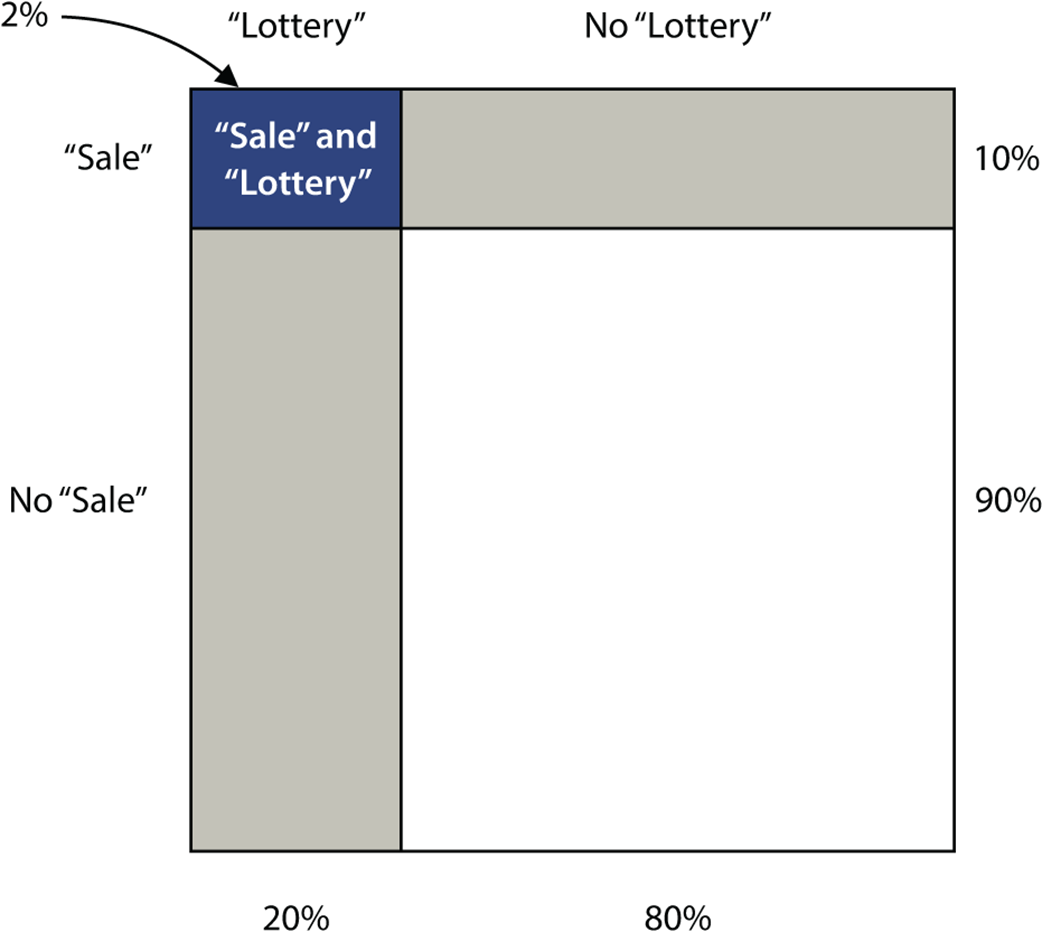
Visualizes the product rule by estimating the percentage of emails containing both lottery and sale as the product of their separate percentages. section 8.7








