Insight is a novel understanding: a connection between pieces of information that had seemed unrelated. It is more than collecting facts or noticing obvious relations. For programmers, its value lies in turning knowledge and experience into a useful next move—a piece of code, a solution, or a publication. section 2.4 section 7.4.1
The familiar lightbulb moment is only the visible part of a longer process. Productive insight follows conscious engagement with a problem, periods of incubation, and then illumination. Like a detective assembling clues, a creative programmer gathers fragments until an unexpected pattern fits the larger picture. section 7.4
Treat insight as a habit to cultivate, not a mysterious gift:
- Keep notes searchable and revisit them. A maintained collection makes it easier to reconnect ideas later instead of relying on memory. section 2.4 section 2.6
- Combine prior knowledge and experience around the problem at hand; unusual combinations are a source of novelty. section 2.4
- Work alone or with others according to the problem. Solitude can help thought, while discussion and pair programming can uncover assumptions and build shared understanding. section 7.4.1 section 5.4.8
- Verify every flash of understanding. Sudden ideas can feel truer than step-by-step reasoning while still carrying bias. section 5.4.2
From “cannot be done” to a testable idea
When someone says a task cannot be done with the current technology, first ask what supports that claim: prior attempts, the present context, or dislike of the stack. Clarifying misconceptions and pairing on the problem can turn a quick judgment into a shared, testable insight without turning the exchange into a contest. section 5.4.8
Figure 7.5 The evolution of seemingly loose data to insight and wisdom. Based on ideas of the Gapingvoid Culture Design Group.
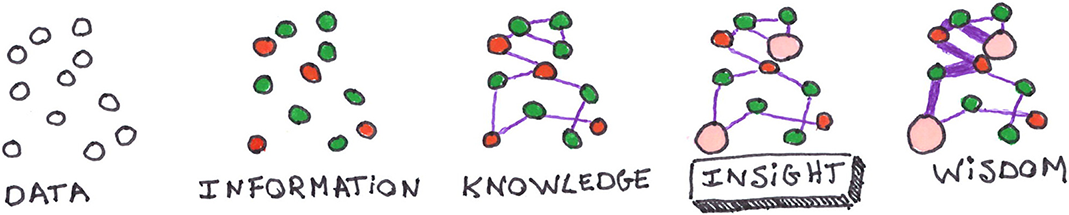
Use the diagram to distinguish loose data, organized information, knowledge through familiar relations, insight through novel connections, and wisdom through meaningful paths between insights. section 7.4.1
Pause over a stubborn problem: which notes, experiences, or clues have you kept separate? Connect them, then test whether the connection survives scrutiny. Humor may also help loosen thought: jokes combine an unexpected element with a logic that can resemble creative insight. section 6.7 section 5.4.2


