When a conversational assistant loses users, aggregate analytics may show that opt-outs increased without revealing where the interaction failed. Instrumentation deliberately collects and stores meaningful data points so teams can analyze conversations, prioritize improvements, and support later processing. section 11.1.3 section 12.2.3
Useful instrumentation can record:
- Breadcrumbs marking the start or completion of major task flows and subflows. section 11.1.3
- The exact conversation step where a user requests an agent or opts out, supporting root-cause analysis. section 11.1.3
- Fixed-format answers and meaningful identifiers stored in context or session variables for later retrieval. section 12.2.3
- Only the sensitive information needed, retained for an appropriate period and reviewed for legal and privacy requirements. section 12.2.3
Tracing an opt-out
A process-oriented bot records the current task flow and step whenever a user requests an agent. Grouping these events may reveal frequent immediate opt-outs during the initial greeting and a separate pattern around collecting address details downstream. The team can then investigate those points instead of treating every opt-out as the same failure. section 11.1.3
Figure 11.2 A breakdown of opt-out occurrences by step can aid in root cause analysis. In this chart, immediate opt-outs show prominently on the left, but trends indicate that there may also be a problem with collecting address details in multiple downstream flows.
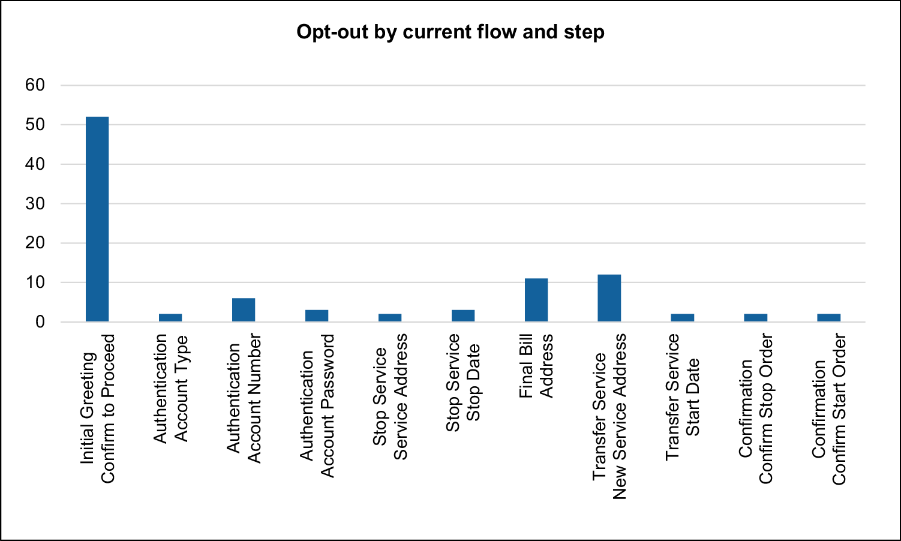
Use the step-level breakdown to connect opt-out patterns with likely trouble spots in a conversational flow. section 11.1.3












