An interaction mode classifies how teams relate while achieving goals or exchanging capabilities. Team Topologies defines three modes and recommends choosing among them according to alignment needs, cognitive load, and changing context. section 11.2 section 11.2.2
Use the mode that best balances team alignment with independent delivery:
- Collaboration: two teams work toward a shared outcome through synchronized work, shared rituals, joint decisions, and frequent communication. It supports close alignment but carries high cognitive load. section 11.2.2
- X-as-a-service: one team consumes another team's capabilities, such as an API, with limited synchronization after onboarding, feature requests, or occasional support. section 11.2.2
- Facilitating: one team temporarily helps another achieve its goal, including urgent support or upskilling, without making the relationship permanent. section 11.2.2
Treat interaction modes as evolutionary choices rather than fixed structures. Excessive collaboration, context switching, slower delivery, or heavy coordination can signal that boundaries or modes need reassessment, although practices and leadership may also be contributing. section 11.4.1 section 11.6
Switching from collaboration to service
Two teams may collaborate closely while clarifying responsibilities, then move toward X-as-a-service when stable boundaries and capabilities make repeated synchronization unnecessary. section 11.2.2 section 11.6
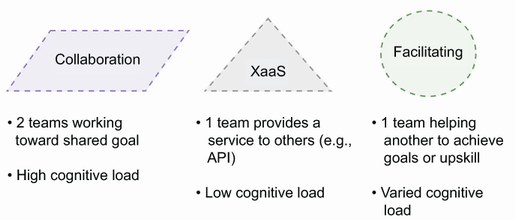
Compare the three interaction modes and their relationship patterns in one visual model. section 11.2.2

