Interoperability lets different software systems exchange data and operate together through compatible interfaces and conventions. In an Iceberg lakehouse, it connects catalogs, ingestion tools, processing engines, query services, BI tools, notebooks, and machine-learning workflows. The architectural tradeoff is between open standards that preserve flexibility and proprietary interfaces that may increase lock-in and integration work. section 4.3.5 section 5.1.4
Assess interoperability through practical platform requirements:
- Specify which tools and interfaces users need, including BI systems, interactive query engines, local notebooks, and machine-learning workflows. section 4.3.5
- Prefer standard APIs and protocols when connecting ingestion, processing, storage, catalog, and query components; proprietary interfaces can require custom adapters and constrain future architecture. section 5.1.4 section 4.3.3
- Verify read and write support rather than assuming that every engine fully implements an interoperability standard. section 4.3.3
- Use the Iceberg REST Catalog specification to provide a language-independent, engine-neutral HTTP interface for metadata retrieval, namespace listing, table registration, and commits. section 7.3.2
- Centralize scan planning, commits, conflict resolution, access control, and governance where appropriate to reduce fragmented client logic and enforce consistent correctness. section 7.3.2
Multi-engine catalog selection
An organization using Spark, Flink, Trino, and external orchestration tools can compare catalogs by asking whether each supports the Iceberg REST Catalog specification, which operations are implemented, how governance is enforced, and whether the deployment supports its cloud or multicloud strategy. A shared standard can reduce engine-specific client libraries while preserving catalog choice. section 7.3.2 section 7.5
Figure 7.9 With the REST Catalog specification, the same client library can be used for all catalogs, reducing fragmentation and improving interoperability between Iceberg catalogs.
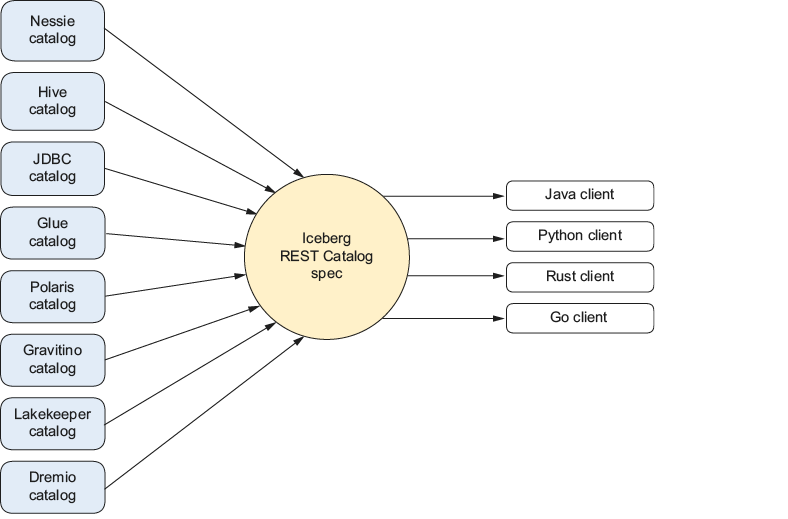
Use the figure to compare fragmented catalog integrations with a shared client library and REST interface. section 7.3.2




