Interoperability is the ability of different health information systems to exchange data and use that information meaningfully. It is a patient-safety and trust problem, not merely a connectivity problem: clinical information spans organizations, formats, and workflows, and errors in usable data can affect care. section 1.5 section 1.1
Fragmented exchange relies on unstandardized files, PDFs, and faxes, creating silos, manual work, and opportunities for error. Even structured data may differ by vendor or workflow and may not support on-demand querying or analysis. Interoperable architecture instead aims for clean, bidirectional, API-driven exchange so systems can share data at scale. section 1.1
Figure 1.1 The day-to-day reality: fragmented systems exchanging data as files and faxes—versus clean, bidirectional exchange through APIs.
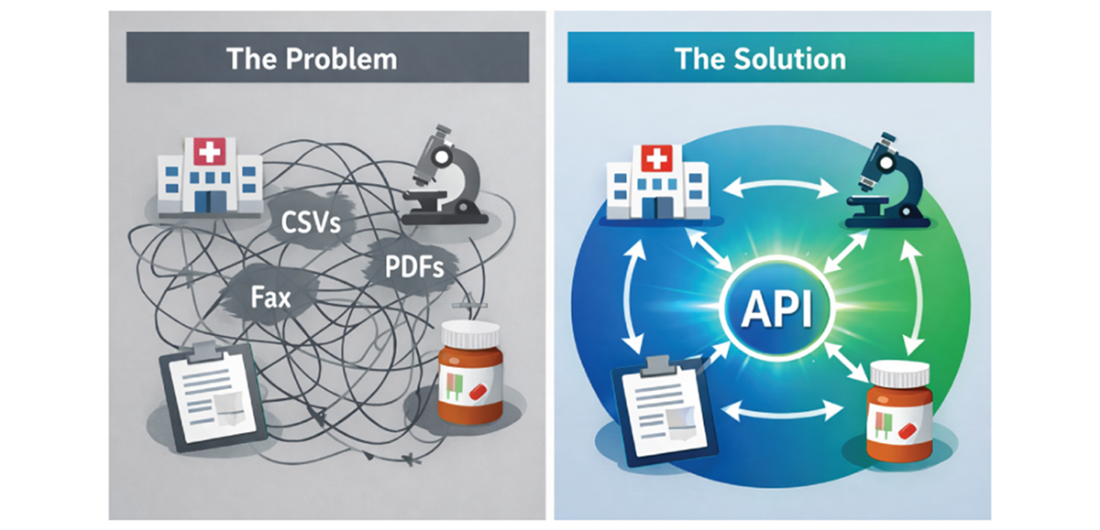
Compare the operational gap between file-and-fax handoffs and bidirectional API exchange. The contrast makes clear why a digital record alone does not guarantee usable exchange. section 1.1
Building for interoperability requires treating exchanged data as clinically consequential:
- Preserve precision so information is technically correct and usable at the point of care. section 1.5
- Design for trust through privacy, security, and regulatory compliance. section 1.5
- Account for identity matching, timestamps, provenance, terminology, and governance, since each can affect clinical outcomes. section 1.5
- Situate product decisions within evolving technical and regulatory frameworks rather than treating health IT as a purely technical domain. section 1.3
The policy direction is from a trust baseline through digitization toward interoperability mandates and patient access. HIPAA established privacy and security expectations; HITECH accelerated EHR adoption; and the 21st Century Cures Act pushed interoperable, API-driven systems. Requirements continue to evolve with technology, policy, and economic change. section 1.2.6 section 1.5
From document exchange to data exchange
A paper intake form, a faxed record, or a PDF can move information between organizations without making it readily queryable or usable in another workflow. The intended transition is toward standardized, real-time sharing and developer-ready APIs, including digital intake workflows and network-to-network exchange that lets data follow patients. section 1.3 section 1.5
Interoperability is increasingly measured by practical exchange rather than EHR installation alone. In 2021, 88% of hospitals reported electronically sending and obtaining patient information through querying or electronically receiving summary-of-care records. The remaining challenge is to create value and better access for patients and clinicians while sustaining precision and trust. section 1.3 section 1.5