IPv4 address exhaustion is the depletion of globally usable IPv4 addresses as demand exceeds the available 32-bit address space. IPv4 provides 4,294,967,296 possible addresses, but reserved ranges—including multicast and experimental ranges—cannot all be assigned to hosts. section 20.1
Unprecedented connectivity, inefficient address use, and continuing growth have made the remaining addresses insufficient. IANA distributes address space to Regional Internet Registries (RIRs), which assign it to organizations such as Internet service providers. section 20.1
Important consequences and responses include:
- CIDR improves efficiency by allocating address space more precisely. section 20.1
- Private IPv4 addresses and NAT extend the usable lifetime of IPv4 networks. section 20.1
- IPv6 provides the long-term solution, using 128-bit addresses instead of IPv4’s 32-bit addresses. section 20.1 section 20.6
Regional exhaustion
ARIN announced exhaustion of its IPv4 address pool in 2015, followed by RIPE NCC in 2019 and LACNIC in 2020. These announcements illustrate that regional address pools can be depleted even while IPv4 remains widely deployed. section 20.1
Figure 20.1 The five RIRs. AFRINIC serves Africa. APNIC serves the Asia-Pacific region. ARIN serves Canada, the United States, parts of the Caribbean, and Antarctica. LACNIC serves most of the Caribbean and all of Latin America. RIPE NCC serves Europe, West Asia, Central Asia, and Russia.
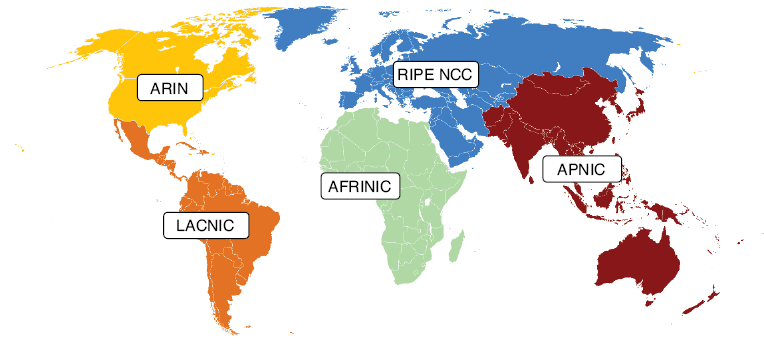
Use the regional map to identify the five RIRs and the geographic areas they serve. section 20.1


