When a chatbot misreads an intent, it may give the wrong response or fail to start the right flow. K-fold cross-validation estimates how consistently an intent classifier handles its existing training examples, without requiring additional annotated data. section 4.2.1
The test repeatedly holds out part of the training set:
- Set aside a portion as a temporary blind test set and train a temporary classifier on the rest. section 4.2.1
- Run the held-out examples through the classifier, score its predictions, and return those examples to the training set. section 4.2.1
- Repeat the process k times; review accuracy, precision, and recall to find intents that may be confusing the classifier. section 4.2.1
A baseline for a chatbot
In a 125-question test, the classifier predicted 105 correctly, for 84% accuracy. Two intents with only three training examples had zero recall, illustrating how sparse data can make fold-based results unstable. section 5.1.3
Figure 4.5 K-fold cross validation and generated test data are suitable for situations where representative data is not available. Once a solution is deployed to production, representative blind test data will produce the most reliable measurement of your classifier’s ability to understand.
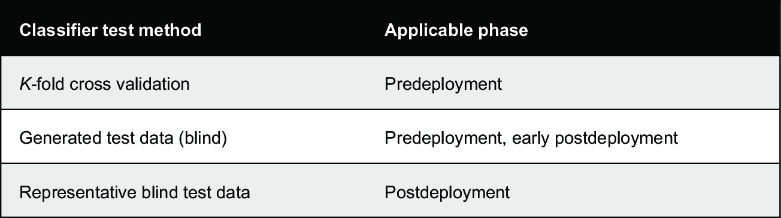
Use the figure to distinguish when cross-validation is useful from when representative blind data is available after deployment. section 4.2.1
Treat the result as a baseline, not a guarantee of production performance: cross-validation reflects consistency within the training data. Once the chatbot is live, representative blind tests built from actual user utterances provide a more reliable measure. section 4.2.1 section 5.1.3











