Kind runs lightweight Kubernetes clusters as containers, making it suitable for portable development environments on machines that support containers. For distributed applications, a shared local cluster can serve multiple development environments instead of provisioning one cluster per application. section 3.3.1
A practical kind workflow is:
- Activate the development environment and move to the platform folder. section 3.3.1
- Run the cluster-provisioning script to create the devex-cluster kind cluster. section 3.3.1
- Verify the active Kubernetes context and inspect the cluster nodes with kubectl. section 3.3.1
Shared local cluster
A platform setup provisions devex-cluster with kind, then deploys supporting resources such as Contour for ingress and CloudNativePG for PostgreSQL operations. Podman Desktop can show the cluster running as a single container. section 3.3.1
Figure 3.9 A Kubernetes cluster can either be provisioned inside each development environment or on the host machine so that it can be shared. Which option to choose depends on the use case.
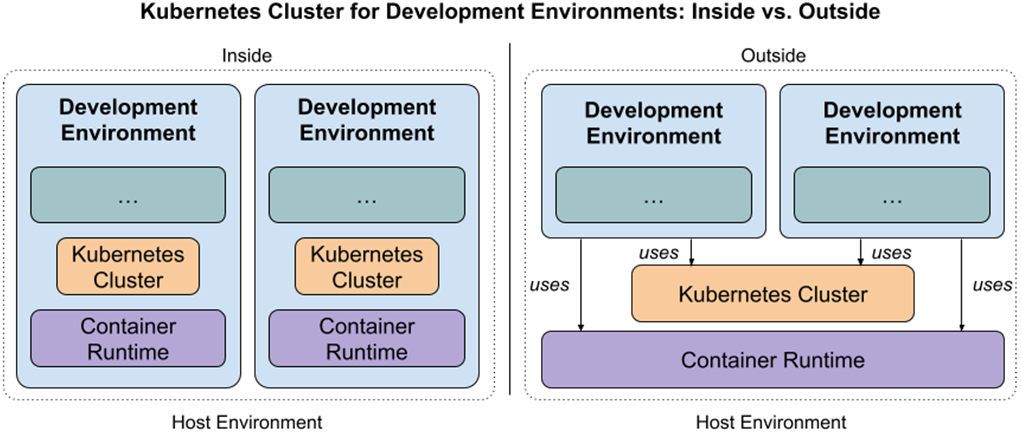
Use the diagram to compare a Kubernetes cluster placed inside each development environment with a shared cluster running on the host. section 3.3.1



