liveBook · Manning

Kind

As explained in Platform Engineering on Kubernetes

kind is a tool that runs Kubernetes clusters using Docker containers, primarily for local development and testing.

Kind (Kubernetes in Docker) runs a local Kubernetes cluster in Docker, giving developers a laptop-based environment for deploying and experimenting with cloud-native applications. section 2.0

Use Kind when a local Kubernetes environment is more practical than a remote cluster:

  • Create a disposable cluster without paying for remote infrastructure or depending on shared development resources. section 2.1.1
  • Deploy a walking-skeleton Conference application, inspect its Kubernetes resources with kubectl, and package or install it with Helm. section 2.0
  • Experiment with scaling, failures, state, replicas, and fallback mechanisms in a controlled environment. section 2.6

Three-node local Conference cluster

A local Kind setup can simulate three nodes and map a special port for an Ingress controller, allowing requests sent to http://localhost to reach the Conference application. section 2.1.1

Figure 2.1 Kubernetes cluster Local vs. Remote setups.
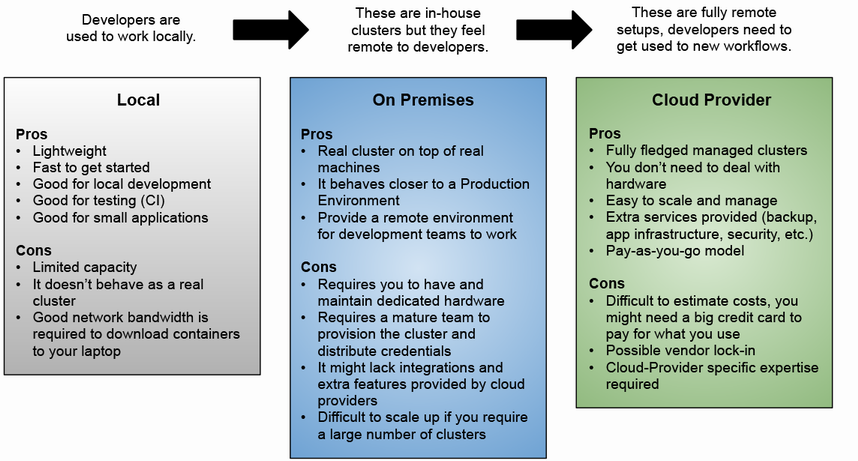
Compare local and remote Kubernetes setups before choosing where development workloads should run. section 2.1.1


How Platform Engineering on Kubernetes covers it

How deep it goes
Explains local setup, simulated nodes, port mapping, and resource limits; stops short of describing a real multi-machine cluster.
Examples
Uses a three-node local cluster, a Conference application, Ingress port mapping, resource inspection, and service scaling experiments.
What it assumes
Assumes familiarity with Kubernetes applications while introducing local-cluster use for development and experimentation.
What you can do after
Operate a local Kubernetes cluster, deploy an application, inspect resources, scale services, and verify runtime behavior.
How it connects
Connects Kubernetes with Docker, Helm, kubectl, Ingress controllers, microservices, scaling, and resilience.

Also explained in

Compare how 3 books explain Kind →

Related concepts

This explainer was generated by Manning's knowledge graph from the text of Platform Engineering on Kubernetes. The section links point to the parts of the book it draws on.
