A keyword search can miss a useful document when the query and document use different terms for related things. A knowledge graph gives search a way to represent those things and their relationships, so it can interpret queries in the context of a domain rather than match strings alone. section 1.2.4 section 5.1
A node represents an entity or concept; an edge connects two related nodes. An ontology describes relationships between types of things, while a knowledge graph instantiates those relationships with particular things. For example, “animal eats food” describes a type-level relationship; “John eats food” connects particular nodes. Following edges can reveal further connections that were not expressed as a single direct relationship. section 2.4 section 5.1
Two approaches put these relationships to work in search:
- Model an explicit graph: store known entities and relationships as nodes and edges, including relationships learned from text. section 5.0 section 5.1
- Traverse a semantic knowledge graph (SKG): index documents, then discover and rank term relationships from their shared documents. The inverted index finds documents containing a term; a forward index supplies terms from those documents. No separately modeled set of graph edges is required. section 5.4.3
Figure 5.5 Three representations of an SKG. The data structure view shows terms mapped to sets of documents, the set-theory view shows how the intersection of sets of documents forms the relationship between them, and the graph view shows the nodes and edges.
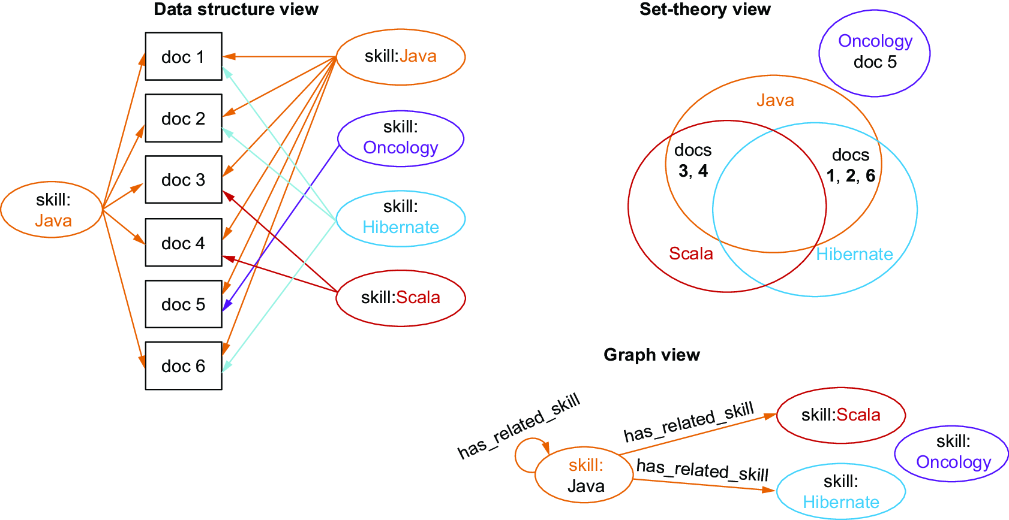
Compare the document sets shared by terms with the nodes and edges inferred from those overlaps. section 5.4.3
Expand a query from related terms
In an indexed health collection, an SKG query for “advil” can rank “motrin,” “aleve,” and “ibuprofen” as related terms. A search request can retain the original term while adding weighted alternatives, such as advil OR motrin^0.59897 OR aleve^0.4662 OR ibuprofen^0.3824. The weights and matching requirements matter: expansion can favor broader recall, stricter precision, or better ranking without changing which results qualify. section 5.4.1 section 5.4.5
Treat inferred relationships as evidence of contextual association, not automatically as factual or interchangeable meanings. An SKG works best when related terms recur across many documents; collections with little document-to-document overlap offer less to learn from. Explicit modeling remains useful when a relationship must be stated directly. Both approaches can support query interpretation, while SKG terms can also drive content-based recommendations. section 5.4.1 section 5.4.2 section 5.4.6











