Why might a large language model give a wrong answer to a factual question? One way to think about its knowledge is as a knowledge graph: individual entities are nodes, and relationships between them are edges. section 5.7
Figure 5.8 An example knowledge graph
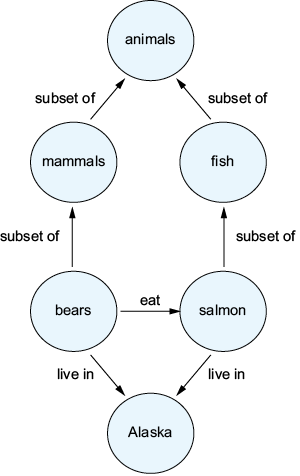
The diagram shows a small collection of entities and the relationships connecting them. section 5.7
For a language model, this graph is an analogy, not an inspectable map of its weights. Imagine that some relationships are less certain than others because of the information available during training. When information is limited or conflicting, the model may guess and produce a hallucination. Its inner workings are too opaque to determine exactly what knowledge it contains. section 5.7











