The Kubernetes API is the interface for creating and managing resources on a cluster. It gives developers a way to run containerized applications without needing to understand the cluster’s computer topology or networking details, while giving development and operations teams a shared language for application design and operation. section 3.1.1 section 3.3.3
In a Kubernetes-based inner loop, the API turns application deployment into an explicit workflow. After packaging code as a container image, developers load that image into the cluster, define or update resource manifests, and apply those manifests to create or update resources. These repeated steps can slow feedback compared with running directly on an application runtime. section 3.3.2 section 3.5
Use the API through YAML manifests and kubectl to describe the resources an application needs:
- Deployment manages the lifecycle of a stateless replicated application; each replica contains a Pod representing the application container. section 3.3.3
- Service makes a Deployment available for network calls, usually from within the cluster. section 3.3.3
- Ingress makes a Service available for network calls from outside the cluster. section 3.3.3
- ConfigMap and Secret can supply application properties or credentials; Base64 encoding alone does not make Secret data encrypted. section 3.3.3
Deploying an appointments service
An appointments service can be deployed by first provisioning PostgreSQL, building a local image, loading it into a kind cluster, and applying a configuration directory with kubectl. Its Deployment manifest identifies the image and reads PostgreSQL connection values from a Secret; kubectl can then list resources by the application label and later delete the applied configuration. section 3.3.3 section 3.5
Figure 3.11 The “Run” activity in the inner loop on Kubernetes involves a series of additional tasks.
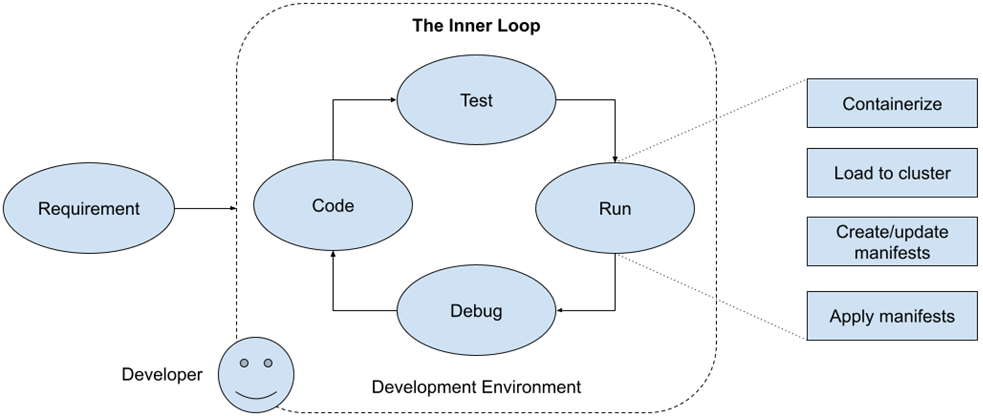
This workflow view shows why a Kubernetes inner loop requires image packaging, cluster loading, manifest updates, and manifest application for each code change. section 3.3.2
The practical choice is to keep API interaction aligned with the development loop: use manifests to express the desired application resources, and use tools that reduce image-building and deployment friction. Kubernetes supplies the resource API; tools such as kubectl, kind, Buildpacks, and ko support different parts of the local workflow. section 3.3.3 section 3.5






