A Kubernetes namespace partitions one physical cluster into virtual clusters. It creates a resource boundary for teams or users while allowing workloads to share underlying servers. section 1.2.5 section 3.3.7
Use a namespace as an operational boundary for shared compute:
- Create a namespace and assign quotas for CPU, memory, and GPU capacity. section 3.3.7
- Map users to namespaces in the training service. section 3.3.7
- Resolve the submitting user's namespace before placing the training executable through the Kubernetes API. section 3.3.7
- Let Kubernetes track live usage and reject launches when the namespace lacks capacity. section 3.3.7
Isolating training workloads
A training platform assigns each user to a namespace with CPU, memory, and GPU quotas. Kubernetes places the submitted job there, enforces the available capacity, and removes resource tracking and isolation logic from the training service. section 3.3.7
Figure 3.10 Creating machine pools within the training cluster to set up the resource consumption boundary for different users.
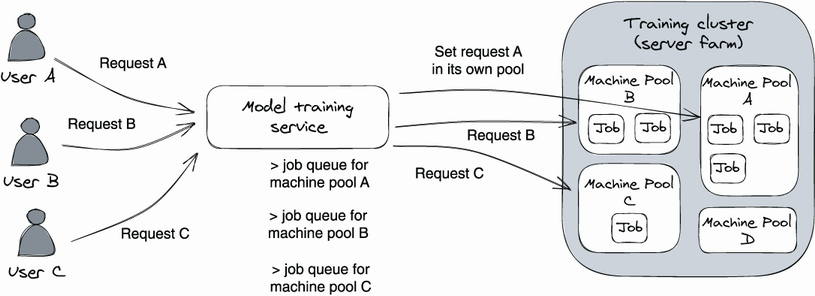
Relate namespaces to the resource-consumption boundary created for different users inside a shared training cluster. section 3.3.7




