A label is human-facing text that explains a coded value or business concept. Prefer plain words such as "checking" and "savings" over cryptic codes when possible. section 8.5.2
Preserve the code, add the label
When shared systems require account code 7, return {"type": 7, "typeLabel": "savings"} or {"type": {"code": 7, "label": "savings"}}. Labels help developers interpret data and can be displayed to users. section 8.5.2
Choose the delivery pattern according to consumer needs:
- Inline labels make responses immediately usable but repeat the same value across many records. section 13.5.4
- Dedicated operations such as GET /codes/transaction-category/values centralize labels and can be cached, while requiring an extra call. section 13.5.4
- Use Accept-Language to translate labels for end users; keep property names and machine-readable codes stable. section 9.7.2
Figure 8.12 Contrasting non-human-readable and human-readable bank account type codes
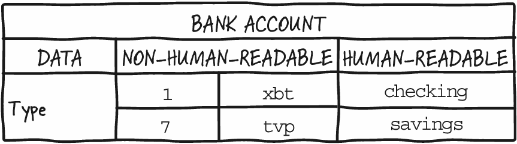
Compare cryptic and human-readable bank account type codes. section 8.5.2


