Leading by example means showing the standards you expect through your own behavior. For a lead developer, that includes staying accountable, responding constructively under pressure, and supporting the team’s success rather than measuring success only by personal output. People notice whether actions match promises. section 1.2.1 section 1.3.3
Make the example visible in everyday work:
- Keep commitments. Before promising a deadline, check whether the work fits your schedule. If you cannot deliver, say when you can; if you make a mistake, apologize. section 1.3.3
- Stay calm in an emergency. Follow an emergency plan, assign tasks, communicate each step, and keep the project team informed. If a fix requires deployment, give QA the timing needed to prepare for testing. section 1.2.1
- Listen and invite feedback. Be responsive to colleagues and team members, including when their criticism reveals something you need to improve. section 3.1.2
- Try changes yourself. When proposing a new tool or development process, show that you are willing to experiment, explain the expected benefit, and invite the team’s feedback. section 6.1.2
When commitments become unrealistic
A lead developer repeatedly promises tasks by deadlines but is too overloaded to finish them. Pushing back on lower-priority work makes the schedule more realistic. It also makes it easier for teammates to raise their own workload concerns and plan a response together. section 1.3.3
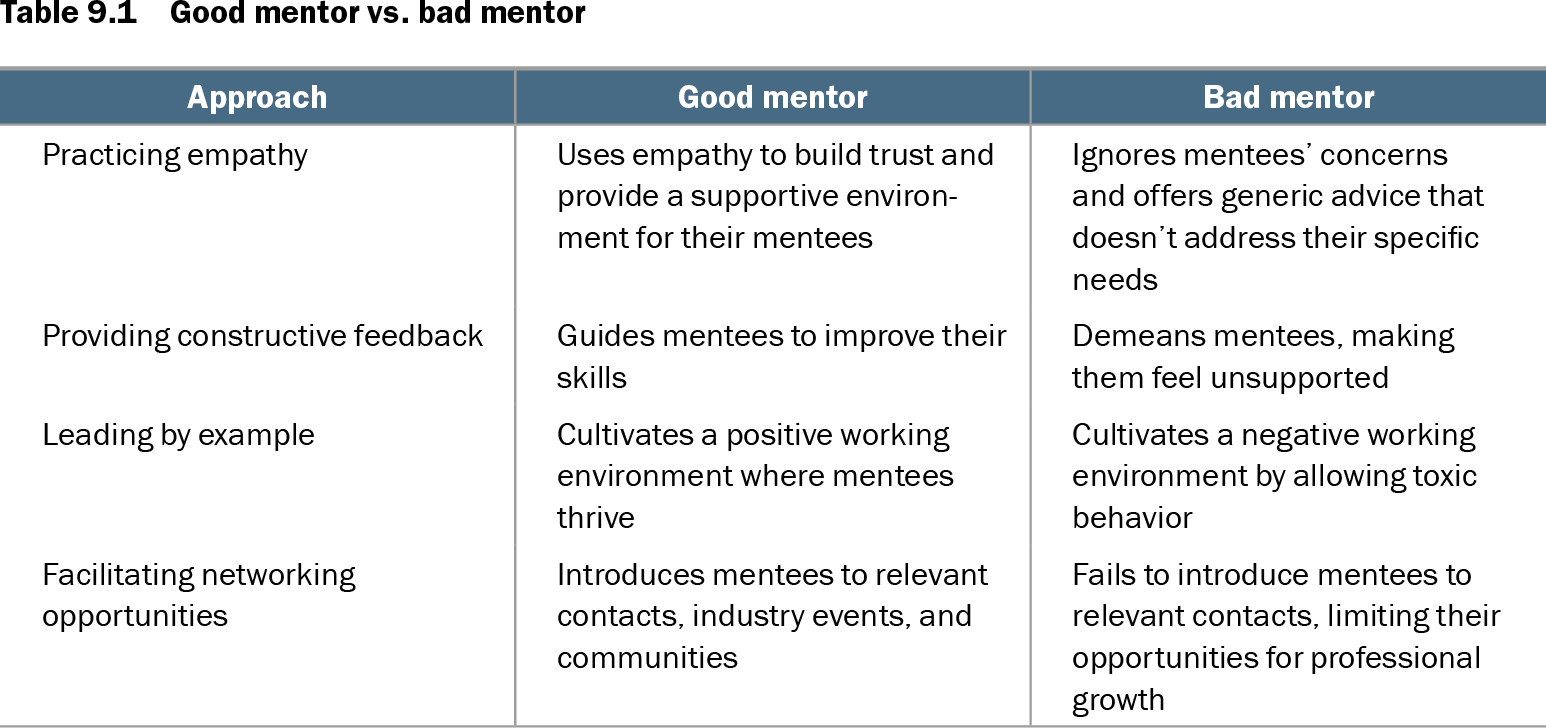
Leading by example does not mean having a perfect response to every situation. Leadership soft skills have no fixed script: seek feedback, learn from mentors, and adjust as you go. For mentors, the same principle means sharing knowledge and meeting challenges positively, not allowing harmful behavior or withholding support. section 3.1.2 section 9.1
Table 9.1 Good mentor vs. bad mentor (view table figure)
| Approach |
Good mentor |
Bad mentor |
|---|---|---|
| Practicing empathy |
Uses empathy to build trust and provide a supportive environment for their mentees |
Ignores mentees’ concerns and offers generic advice that doesn’t address their specific needs |
| Providing constructive feedback |
Guides mentees to improve their skills |
Demeans mentees, making them feel unsupported |
| Leading by example |
Cultivates a positive working environment where mentees thrive |
Cultivates a negative working environment by allowing toxic behavior |
| Facilitating networking opportunities |
Introduces mentees to relevant contacts, industry events, and communities |
Fails to introduce mentees to relevant contacts, limiting their opportunities for professional growth |
Compare how a mentor’s example can foster a positive working environment or permit a negative one. section 9.1