liveBook · Manning

Decision boundary

As explained in Machine Learning System Design

A decision boundary is the boundary in an input space that separates regions assigned different model decisions or predicted classes.

A decision boundary separates regions assigned different model decisions. Its margin matters: a narrow, non-robust boundary can make precision and recall change substantially when small noise is added. section 7.4

Because precision and recall depend on the selected threshold, evaluate boundary stability rather than relying on a single metric value. Poisson bootstrap, noise addition, and lower confidence bounds provide more reliable performance estimates. section 7.4

Testing boundary robustness

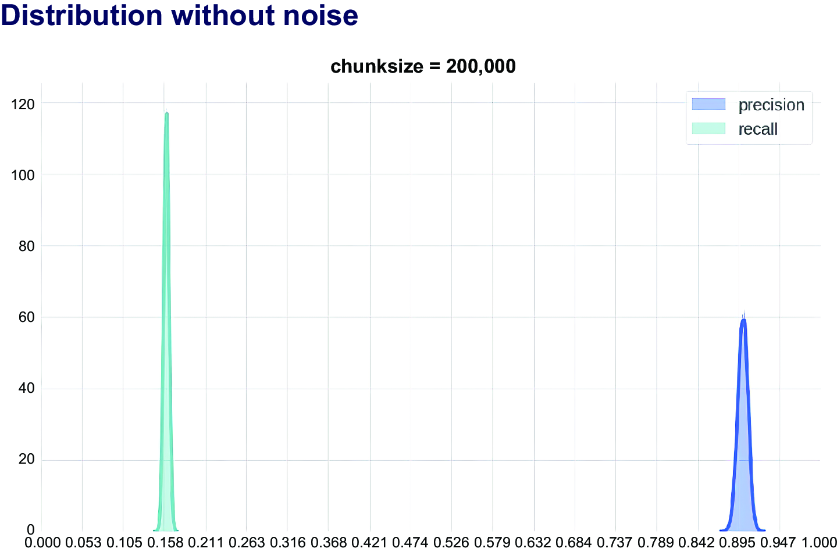
Compare precision and recall distributions for bootstrapped datasets with and without normally distributed noise. Large shifts, such as increased recall paired with decreased precision, indicate a narrow margin. section 7.4

Distribution of precision and recall with sample size of 200;000; every point is a bootstrapped original dataset, no noise added.
sidebar figure

Inspect the bootstrapped precision and recall distribution without added noise, then compare it with the corresponding noisy distribution. section 7.4


How Machine Learning System Design covers it

How deep it goes
Explains robustness through metric distributions, Poisson bootstrap, noise addition, and confidence bounds without deriving boundary geometry.
Examples
Uses precision and recall distributions from bootstrapped datasets with and without added noise.
What you can do after
Diagnose boundary fragility by comparing metric shifts and applying robust confidence-bound estimates.
How it connects
Connects decision boundaries with classification thresholds, precision, recall, specificity, Poisson bootstrap, and confidence intervals.

Also explained in

Compare how 4 books explain decision boundary →

Related concepts

This explainer was generated by Manning's knowledge graph from the text of Machine Learning System Design. The section links point to the parts of the book it draws on.

