An exponential growth curve represents a quantity increasing by a constant multiplicative factor over equal input intervals. It makes rapidly widening differences easier to see than verbal descriptions alone. section 1.1
In data processing, exponential growth frames a widening contest between generated data and the hardware available to transfer, store, and analyze it. The gap increases as data rates double faster than computing capacity. section 1.1
Data rates versus computing capacity
Edholm’s Law models telecommunications data rates doubling every 18 months, while Moore’s law models transistor counts doubling every two years. Internet traffic broadly follows the data-growth pattern, illustrating why processing and storage requirements escalate. section 1.1
Figure 1.1 The ratio between Moore’s law and Edholm’s law suggests that hardware will always lag behind the amount of data being generated. Moreover, the gap will increase over time.
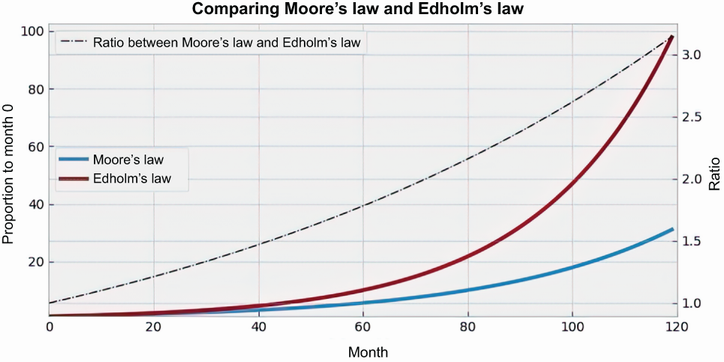
Compare the curves for data generation and hardware capability to see why the hardware deficit widens over time. section 1.1

