An LLM application integrates one or more large language models into software that addresses practical tasks such as natural language understanding, text generation, or sentiment analysis. Its effectiveness depends on coordinating hardware, software, model behavior, and a clearly defined application purpose. section 1.2
Building an LLM application typically requires:
- Selecting suitable computational hardware, including GPUs, because LLMs are compute-intensive. section 1.2
- Defining the target task, such as language understanding, text generation, or sentiment analysis. section 1.2
- Training or fine-tuning models with extensive datasets when application-specific performance requires it. section 1.2
Retrieval-Augmented Generation illustrates a common architecture: retrieve relevant information from a selected data source, then provide it to an LLM for more accurate and current responses. Unlike link-only search, the application can return a written answer with source URLs. section 1.2
A retrieval-backed answer
An Ares API example retrieves information about taco spots in San Francisco and returns answers with web URLs as sources rather than only displaying search links. section 1.2
Figure 1.4 Retrieval Augmentation Generation is used to enhance the capabilities of LLMs, especially in generating relevant and contextually appropriate responses. The approach involves incorporating an initial retrieval step before generating a response to leverage information from a knowledge base.
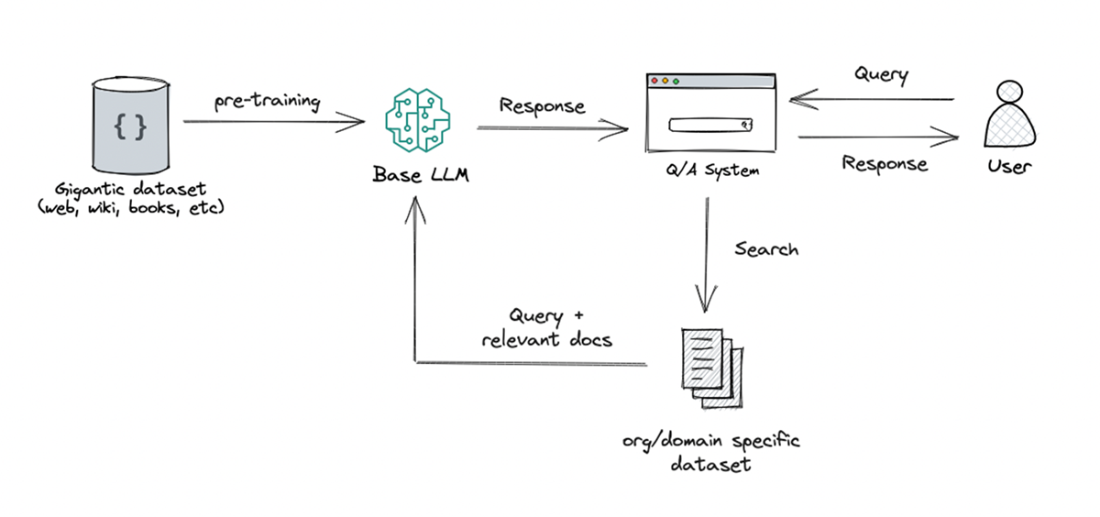
Use the architecture figure to trace how an initial retrieval step supplies knowledge-base context before response generation. section 1.2


