A MAC (Media Access Control) address is a 48-bit identifier assigned to a network interface card (NIC). It is usually written as twelve hexadecimal digits in six pairs, such as 00:1B:4A:F0:37:4C. MAC addresses identify devices for communication on the same local network and belong to the Data Link layer of the OSI model. section 11.5.1 section 11.12
A MAC address connects physical network hardware to local network communication:
- A device may have multiple NICs, such as separate wired Ethernet and wireless Wi-Fi interfaces; each interface has its own MAC address. section 11.5.1
- The first six hexadecimal digits identify the NIC manufacturer, while the remaining three bytes identify the individual interface. section 11.5.1
- Switches use MAC addresses to forward traffic on a local network, while IP addresses identify devices for broader network routing. section 11.10 section 11.5.1
Why a MAC address is not authentication
A device can modify its MAC address through software and impersonate a legitimate system. Because a switch may then forward traffic to the spoofed device, a MAC address should identify network communication rather than serve as a security credential. section 11.5.1
Figure 11.5 Structure of a 48-bit MAC address with 24-bit Organizationally Unique Identifier (OUI) prefix plus 24-bit vendor-assigned device identifier
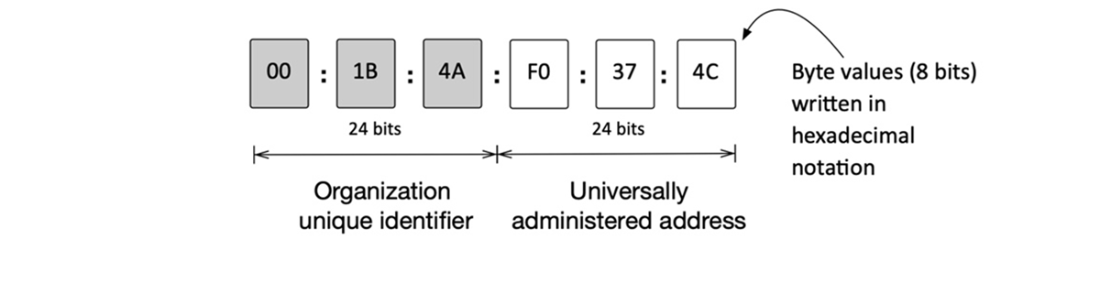
Use the diagram to view the 48-bit structure: a 24-bit Organizationally Unique Identifier prefix followed by a 24-bit vendor-assigned device identifier. section 11.5.1


