A machine learning workflow is the path from defining a useful problem to operating—and eventually retiring—a model. It is a loop, not a one-way checklist: changing requirements, data, or model performance can send a team back to earlier decisions. section 1.4.1 section 2.1
Use the phases to organize work, while allowing steps to be revisited, combined, or skipped when appropriate:
- Define the problem with stakeholders, then collect and prepare data for training and evaluation. section 2.1 section 1.5
- Version data, automate training in a pipeline, and track models and their supporting code so results remain reproducible. section 1.5 section 2.1
- Deploy the model for use, then monitor data and model behavior. Revisit earlier phases when performance or conditions change; retire models when appropriate. section 6.0 section 1.4.1
Production work needs more than a successful notebook experiment. Kubeflow Pipelines can connect stages as components that pass data downstream; feature stores can supply prepared features for training and serving. Deployment and monitoring then make the trained model an operating service whose behavior can be checked over time. section 1.3.3 section 6.0
When the loop turns back
If a model performs poorly during training, return to data preparation rather than treating deployment as the inevitable next step. A deployed used-car price predictor may likewise need new versions as customer needs and market conditions change. section 1.4.1 section 2.1
Figure 2.2 ML as a loop
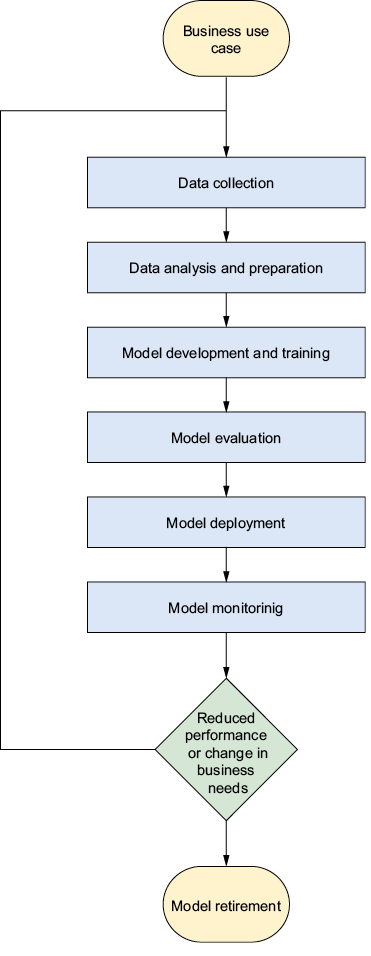
The loop diagram reinforces that a model changes through repeated problem, data, and model decisions rather than a single pass. section 2.1






