liveBook · Manning

Manifold

As explained in Build AI Drug Discovery Pipelines

A manifold is a lower-dimensional mathematical space embedded in a higher-dimensional space that locally resembles ordinary Euclidean space.

A manifold is a lower-dimensional shape embedded in a higher-dimensional space that looks simple locally. A bent line can form a circle, while Earth’s surface is a two-dimensional manifold in three-dimensional space. section 7.1.4

The manifold assumption treats real-world high-dimensional data as lying on or near a lower-dimensional surface. PCA assumes that surface is linear; nonlinear manifold learning can instead preserve local structure and unroll shapes such as the Swiss roll. section 7.1.4

In machine learning, the distinction matters because:

  • PCA can flatten nonlinear structure without keeping similar points nearby. section 7.1.4
  • A nonlinear projection can unroll a two-dimensional manifold so that a linear model separates colored point classes. section 7.1.4
Figure 7.5 Comparison of PCA to a more complex manifold learning algorithm on the Swiss Roll data set.
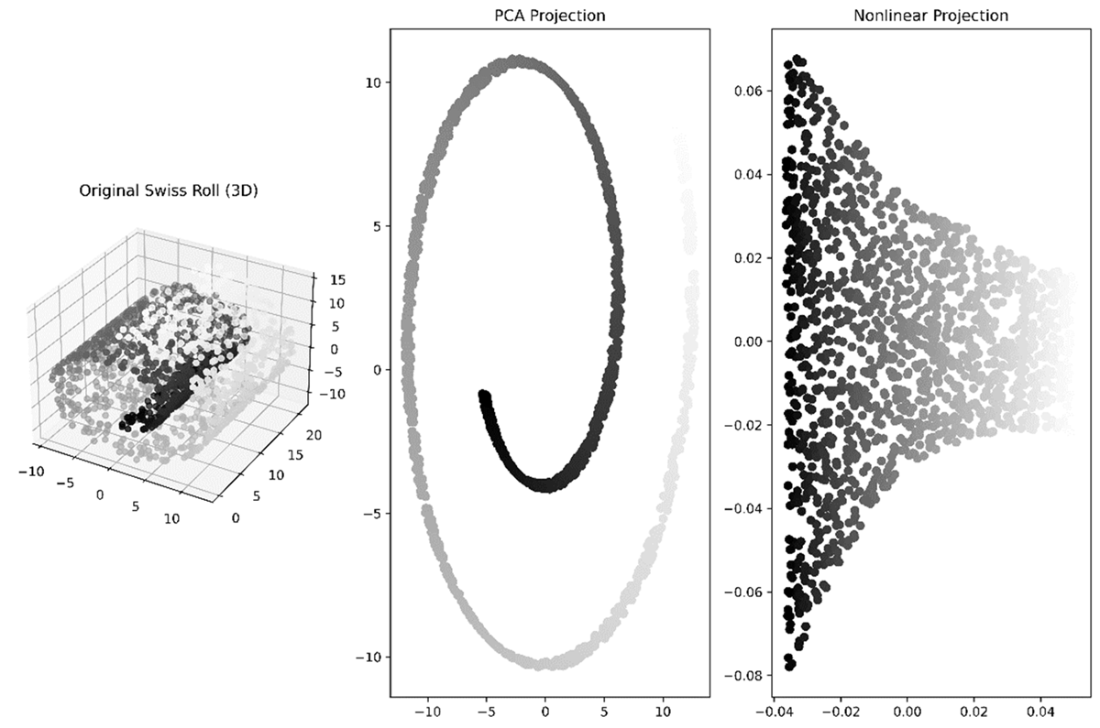
Compare PCA’s flattened Swiss-roll representation with a nonlinear manifold-learning projection. section 7.1.4


How Build AI Drug Discovery Pipelines covers it

How deep it goes
Explains geometric intuition, the manifold assumption, and PCA’s failure on nonlinear structure without formal derivation.
Examples
Uses a bent line, Earth’s surface, the Swiss roll, and colored-point classification as concrete examples.
What it assumes
Builds from basic geometry and PCA while defining manifolds and the lower-dimensional manifold assumption.
What you can do after
Evaluate when nonlinear dimensionality reduction may preserve structure that linear PCA cannot represent.
How it connects
Connects manifolds to PCA, nonlinear manifold learning, dimensionality reduction, UMAP, and linear classification.

Also explained in

Compare how 4 books explain manifold →

Related concepts

This explainer was generated by Manning's knowledge graph from the text of Build AI Drug Discovery Pipelines. The section links point to the parts of the book it draws on.

